Define public administration and explain its evolution in India.
In short
Public administration is the machinery that implements government policy and delivers public services, and in India it evolved from a colonial apparatus of control under the Indian Civil Service into a developmental, citizen-oriented system. Its constitutional anchors include the All India Services (Article 312) and civil service protections (Article 311).
Model answer
Ghissu Editorial · Verified 4 Oct 2026 · 309 words
Colonial Legacy
British-era ICS emphasized control and economic exploitation with rigid hierarchy. Key reforms included Mayo (1870), Ripon (1882), Decentralization (1907), and Government of India Act (1935), which introduced provincial autonomy and expanded administrative roles.
Post-Independence Transformation
Shifted focus to socio-economic development, retaining Weberian bureaucracy and protection against arbitrary dismissal under Article 311; federalism ensured by Article 355 and the Seventh Schedule1. The All India Services Act (1951), made under Article 312, governs services like the IAS and IPS to maintain administrative stability.
Institutional Reforms
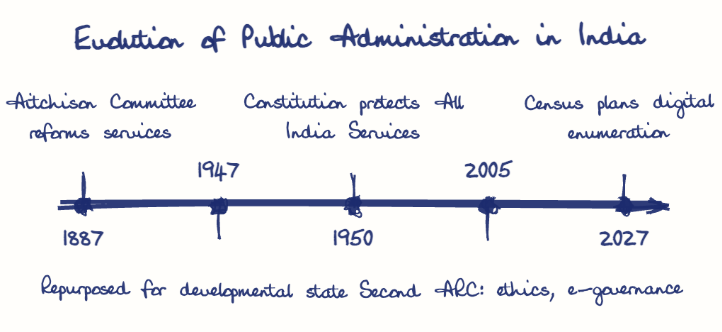
Committees like the Aitchison Committee and Second ARC (2005) promoted ethics, citizen-centricity, and e-governance reforms. The Second ARC emphasized transparency, accountability, and the use of technology to improve governance outcomes.
Capacity Building & Decentralization
Second ARC stresses professionalization; empowering local bodies improves responsiveness and reduces bottlenecks, especially in states like Andhra Pradesh4. Strengthening Panchayati Raj Institutions is vital for grassroots governance.
This model answer is indicative and the model can make mistakes; please verify key facts independently.
Practise this question
1Get the answer sheet
Sized for this question.
2Write your answer
Timed, by hand.
3Get it marked
Your score and what to fix.
This chapter in the exam
Public Administration: meaning and evolution in India6 questions
Asked in 3 of 8 sittings since 2008
Most tested: Evolution of Indian administration from ancient statecraft to British colonial civil service and its continuing influence.
- 2025The administrative system of the Gupta dynasty was, in many ways, similar to that of the Mauryan Empire. Discuss the key similarities and differences between the two administrative structures.
- 2025What features of British administration have influenced the Indian administrative system?
All 6 questions, sorted by sub-topic, with model answers and practice.
Question from the official APPSC Group-I Mains 2020 paper. Answer written by Ghissu's engine and checked against our editorial standards. Found an error? Tell us and we correct it within 48 hours.