What features of British administration have influenced the Indian administrative system?
In short
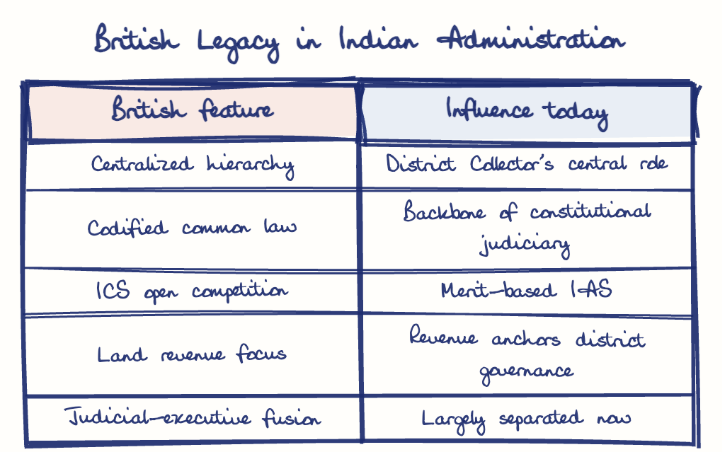
British rule left India a centralized bureaucracy built around the District Collector, a codified rule of law, a merit-based civil service, land revenue administration and combined judicial-executive roles. The IAS, successor to the ICS, continues merit-based recruitment and generalist training, though its order-first, distant colonial ethos needs citizen-centric reform.
Model answer
Ghissu Editorial · Verified 4 Oct 2026 · 278 words
Rule of Law and Legal Framework
British codification introduced a uniform judiciary with district magistrates combining judicial and executive roles, replacing customary laws. This legal uniformity established the basis for India’s constitutional judiciary and legal processes.
Civil Services and Recruitment
The ICS’s merit-based recruitment evolved into the IAS, maintaining professional bureaucracy but requiring reforms for inclusivity, as seen in Andhra Pradesh. The competitive exam system set standards for administrative competence and neutrality.
Revenue Administration’s Fiscal Legacy
Land revenue focus shaped fiscal priorities; post-independence welfare expansion demands capacity building, exemplified by Andhra Pradesh’s DBT schemes. This shift reflects the transition from revenue extraction to developmental administration.
Judicial-Executive Relations
Separation of judicial and executive roles post-independence addresses colonial legacies, with Law Commission1 reports guiding reforms on accountability. Despite separation, administrative influence on law and order remains significant.
Strengthen Decentralization and Judicial Reforms
Empower local bodies through fiscal devolution and capacity building to reduce centralization inherited from colonial rule. Implement Law Commission recommendations to curb executive interference and enhance judicial accountability.
Promote Inclusive Civil Services and Modern Revenue Systems
Reform recruitment and training to foster diversity and citizen-centric attitudes. Modernize revenue administration by integrating technology and welfare-oriented approaches, as practiced in Andhra Pradesh’s direct benefit transfer schemes.
This model answer is indicative and the model can make mistakes; please verify key facts independently.
Sources
Practise this question
1Get the answer sheet
Sized for this question.
2Write your answer
Timed, by hand.
3Get it marked
Your score and what to fix.
This chapter in the exam
Public Administration: meaning and evolution in India6 questions
Asked in 3 of 8 sittings since 2008
Most tested: Evolution of Indian administration from ancient statecraft to British colonial civil service and its continuing influence.
- 2025The administrative system of the Gupta dynasty was, in many ways, similar to that of the Mauryan Empire. Discuss the key similarities and differences between the two administrative structures.
- 2023"The concept of the welfare state had been crystallised in Kautilya's ideas long before it came to be envisioned in Western Europe' — Examine this statement.
All 6 questions, sorted by sub-topic, with model answers and practice.
Question from the official APPSC Group-I Mains 2025 paper. Answer written by Ghissu's engine and checked against our editorial standards. Found an error? Tell us and we correct it within 48 hours.