The administrative system of the Gupta dynasty was, in many ways, similar to that of the Mauryan Empire. Discuss the key similarities and differences between the two administrative structures.
In short
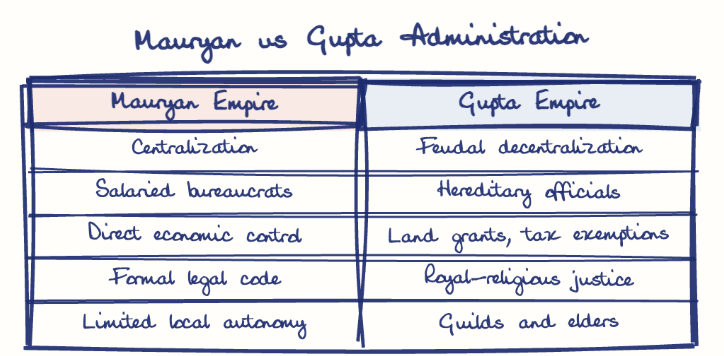
Both empires centred power on the king and governed through provinces and ministers, but the Mauryas ran a centralised, salaried bureaucracy while the Guptas relied on feudatories, hereditary offices and tax-free land grants that diluted central control. In Andhra, Samudragupta made defeated rulers like Hastivarman of Vengi tributaries.
Model answer
Ghissu Editorial · Verified 4 Oct 2026 · 341 words
Provincial Governance
Mauryan provinces were ruled by royal appointees ensuring tight control; Gupta bhuktis and vishayas were often hereditary or feudatory-ruled, indicating increased local autonomy and decentralization.
Administrative Officials
Mauryan amatyas were salaried bureaucrats focused on administration; Gupta officials combined multiple roles, and posts became hereditary, weakening central oversight and increasing local power.
Feudatory Relations
Mauryans had fewer tributary states with more direct administration; Guptas relied heavily on vassal kings for tribute and military aid, reflecting a feudal pattern absent in Mauryan times.
Taxation and Land Grants
Mauryans controlled agriculture and trade with officials like samahartas managing revenue; Guptas granted tax-free agraharas to Brahmanas and officials, reducing imperial revenue and increasing feudal privileges.
Guilds and Local Bodies
Guptas gave guilds and local elites greater autonomy in trade and civic affairs, as seen in seals from Vaishali and plates from Kotivarsha, reflecting participatory local governance and economic decentralization.
Legal Framework
Mauryan emperors were supreme judges with formal legal codes and state-appointed judges; Gupta justice blended royal authority with Brahmanical dharma, involving priests in upholding law.
Local Administration
Gupta villages involved elders, headmen, and guild leaders in governance, contrasting with Mauryan top-down administration, highlighting a shift towards community participation and localized decision-making.
This model answer is indicative and the model can make mistakes; please verify key facts independently.
Practise this question
1Get the answer sheet
Sized for this question.
2Write your answer
Timed, by hand.
3Get it marked
Your score and what to fix.
This chapter in the exam
Public Administration: meaning and evolution in India6 questions
Asked in 3 of 8 sittings since 2008
Most tested: Evolution of Indian administration from ancient statecraft to British colonial civil service and its continuing influence.
- 2025What features of British administration have influenced the Indian administrative system?
- 2023"The concept of the welfare state had been crystallised in Kautilya's ideas long before it came to be envisioned in Western Europe' — Examine this statement.
All 6 questions, sorted by sub-topic, with model answers and practice.
Question from the official APPSC Group-I Mains 2025 paper. Answer written by Ghissu's engine and checked against our editorial standards. Found an error? Tell us and we correct it within 48 hours.