Describe the main features of the 73rd and 74th amendment of the Indian Constitution.
In short
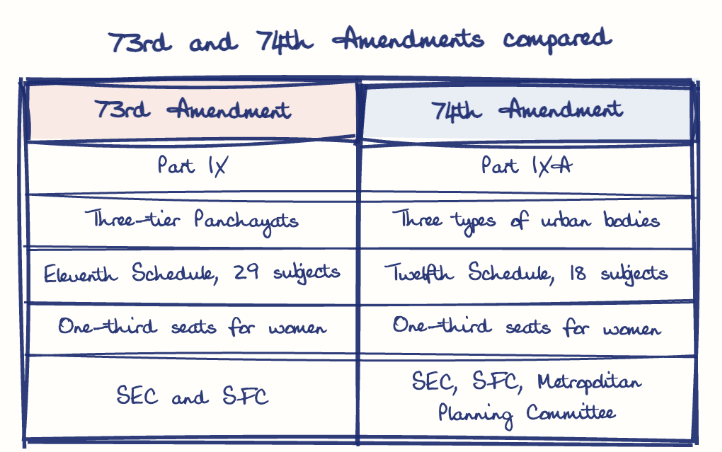
The 73rd and 74th Amendments (1992) gave constitutional status to Panchayats (Part IX) and Municipalities (Part IXA), with direct elections, five-year terms, SC, ST and one-third women's reservation, State Election and Finance Commissions. Panchayats received 29 subjects under the Eleventh Schedule and municipalities 18 under the Twelfth.
Model answer
Ghissu Editorial · Verified 4 Oct 2026 · 259 words
Constitutional Status and Structure
Added Part IX, establishing Panchayats as self-governing bodies with a three-tier system (village, intermediate, district), except in smaller states with populations under two million, which have two tiers.
Commissions and Functions
Created independent State Election and Finance Commissions; Panchayats handle 29 subjects in the Eleventh Schedule, including agriculture, health, education, and social justice, enabling decentralized planning and implementation.
Urban Local Bodies and Classification
Added Part IXA, recognizing Municipal Corporations, Councils, and Nagar Panchayats based on urban characteristics and population size, formalizing urban governance structures.
Functions and Planning
Assigned 18 subjects in the Twelfth Schedule, including urban planning, water supply, and sanitation; mandated Metropolitan Planning Committees to coordinate development in metropolitan areas.
Distinct Schedules and Structures
73rd covers 29 rural subjects with a three-tier system; 74th covers 18 urban subjects with varied urban bodies; both reserve seats for SC/ST and women, and establish election and finance commissions to strengthen local governance.
This model answer is indicative and the model can make mistakes; please verify key facts independently.
Practise this question
1Get the answer sheet
Sized for this question.
2Write your answer
Timed, by hand.
3Get it marked
Your score and what to fix.
This chapter in the exam
Local governance (73rd/74th) and Constitutional Authorities13 questions
Asked in 6 of 8 sittings since 2008
Most tested: 73rd Amendment and the Finance Commission’s role in local body devolution/fiscal federalism
- 2025Discuss the significance of the 73rd Constitutional Amendment Act in strengthening grassroots democracy in India.
- 2025The Finance Commission is considered the backbone of fiscal federalism in India. Examine its role and significance in maintaining the financial balance between the Union and the States.
All 13 questions, sorted by sub-topic, with model answers and practice.
Question from the official APPSC Group-I Mains 2020 paper. Answer written by Ghissu's engine and checked against our editorial standards. Found an error? Tell us and we correct it within 48 hours.