Differentiate between the administrative ideas in Kautilya's Arthashashtra and the Mughal administration.
In short
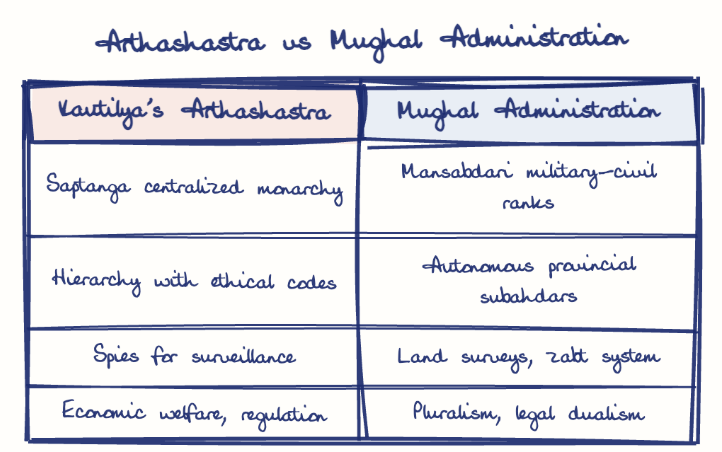
Kautilya's Arthashastra prescribed a centralized monarchy (saptanga rajya) with a hierarchical bureaucracy, spies and welfare-oriented economic regulation, whereas the Mughals ran a plural, revenue-driven imperial bureaucracy with autonomous provincial subahdars. Its mansabdari system fused military and civil ranks, financed by land revenue collected through surveys and the zabt system.
Model answer
Ghissu Editorial · Verified 4 Oct 2026 · 338 words
Centralized Monarchy with Saptanga Rajya
Kautilya’s seven limbs (swami, amatya, janapada, durga, kosha, danda, mitra) formed a tightly integrated governance system emphasizing the king’s supreme authority supported by ministers and allies.
Hierarchical Bureaucracy and Surveillance
The Arthashastra mandated strict roles and ethical codes for officials, using spies extensively for internal security, corruption control, and intelligence gathering to maintain state discipline.
Mansabdari System and Provincial Governance
The Mughal mansabdari system combined military and civil ranks; provinces (subahs) were governed by autonomous subahdars who managed revenue, justice, and military affairs with considerable local discretion.
Cultural and Religious Pluralism
Mughal rulers, especially Akbar, promoted religious tolerance and incorporated diverse elites into administration, fostering a composite culture balancing central authority with local traditions.
Military-Civil Integration
Both integrated military and civil roles, danda in Arthashastra and mansabdari in Mughal rule, ensuring loyalty and efficient governance.
Ethics and Surveillance vs Institutional Checks
Arthashastra’s spy network and ethical codes contrasted with Mughal reliance on revenue audits, judicial oversight, and administrative protocols.
Cultural Pluralism
Mughal policies promoted religious tolerance and legal pluralism, unlike Arthashastra’s uniform ethical governance focused on state stability.
This model answer is indicative and the model can make mistakes; please verify key facts independently.
Practise this question
1Get the answer sheet
Sized for this question.
2Write your answer
Timed, by hand.
3Get it marked
Your score and what to fix.
This chapter in the exam
Public Administration: meaning and evolution in India6 questions
Asked in 3 of 8 sittings since 2008
Most tested: Evolution of Indian administration from ancient statecraft to British colonial civil service and its continuing influence.
- 2025The administrative system of the Gupta dynasty was, in many ways, similar to that of the Mauryan Empire. Discuss the key similarities and differences between the two administrative structures.
- 2025What features of British administration have influenced the Indian administrative system?
All 6 questions, sorted by sub-topic, with model answers and practice.
Question from the official APPSC Group-I Mains 2020 paper. Answer written by Ghissu's engine and checked against our editorial standards. Found an error? Tell us and we correct it within 48 hours.