Differentiate between the powers of the Lok Sabha and the Rajya Sabha on the basis of the following parameters: functions and control over election. Explain, with reasons, the powers that are exercised only by the Lok Sabha.
In short
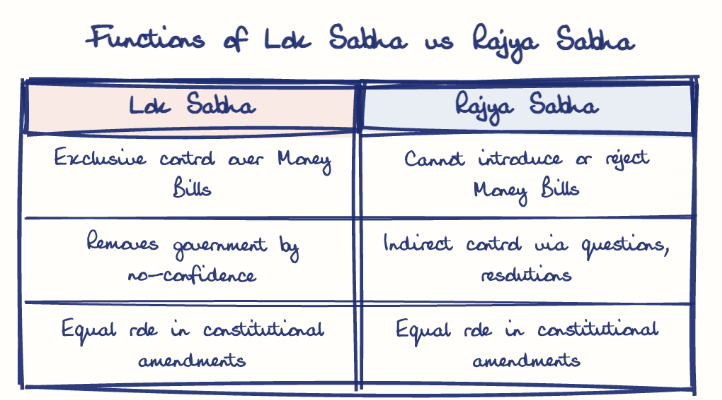
The directly elected Lok Sabha dominates finance and executive control, while the indirectly elected Rajya Sabha holds federal powers under Articles 249 and 312. Only the Lok Sabha introduces Money Bills, votes on demands for grants, disapproves a National Emergency and can remove the government by no-confidence.
Model answer
Ghissu Editorial · Verified 4 Oct 2026 · 320 words
Legislative Authority
Lok Sabha exclusively introduces Money Bills (Article 109), underscoring its primacy in financial governance; Rajya Sabha can only suggest amendments which the Lok Sabha may accept or reject. This highlights the Lok Sabha’s dominant role in financial legislation.
Executive Accountability
The Council of Ministers is responsible solely to the Lok Sabha, which can dismiss it via no-confidence motions (Article 75(3)); Rajya Sabha exercises indirect control through debates, questions, and resolutions but cannot remove the government.
Electoral Mandate
Lok Sabha members are directly elected by the people; Rajya Sabha members are elected by State Legislatures, reflecting federal interests and indirect representation.
Indirect Influence on Rajya Sabha Composition
Political party strength in State Assemblies, such as in Andhra Pradesh, affects Rajya Sabha membership, influencing federal balance and party representation at the national level.
Money Bills and Financial Control
Only Lok Sabha can introduce Money Bills, ensuring taxation and expenditure have direct democratic approval (Article 109). This power reflects the principle that public funds must be controlled by representatives directly elected by the people.
This model answer is indicative and the model can make mistakes; please verify key facts independently.
Sources
Practise this question
1Get the answer sheet
Sized for this question.
2Write your answer
Timed, by hand.
3Get it marked
Your score and what to fix.
This chapter in the exam
Parliament and State Legislatures13 questions
Asked in 8 of 8 sittings since 2008
Most tested: Comparative powers and status of the two Houses, especially Rajya Sabha vs Lok Sabha and Legislative Council vs Legislative Assembly.
- 2025In what aspects is the Legislative Council (Vidhan Parishad) different from the Rajya Sabha, considering its role at the state level?
- 2025What are the steps followed by the Indian Parliament in transforming a Bill into an Act?
All 13 questions, sorted by sub-topic, with model answers and practice.
Question from the official APPSC Group-I Mains 2020 paper. Answer written by Ghissu's engine and checked against our editorial standards. Found an error? Tell us and we correct it within 48 hours.