Explain any five salient features of the Indian Constitution.
In short
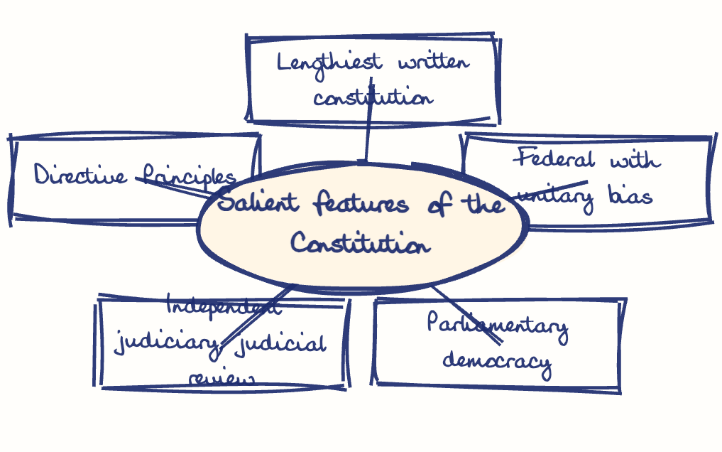
Five salient features of the Indian Constitution are its length as the world's longest written constitution, a federal structure with a unitary bias, parliamentary democracy, an independent judiciary with judicial review, and the Directive Principles of State Policy. Its Article 368 amendment procedure balances flexibility with the basic structure.
Model answer
Ghissu Editorial · Verified 4 Oct 2026 · 256 words
Lengthiest Written Constitution
With about 470 articles and 12 schedules, it addresses India’s complex governance needs, reflecting diversity and administrative detail unmatched globally.
Federal Structure with Unitary Bias
It divides powers between Centre and states but centralises authority through provisions like Article 356 and the All India Services, ensuring national unity amid diversity.
Basic Structure Doctrine
The Kesavananda Bharati case upheld constitutional morality by limiting amendments, preserving core values and preventing arbitrary changes to fundamental features.
Judicial Activism
Judgments such as Puttuswamy (privacy as a fundamental right) and Anuj Garg expanded rights, reflecting progressive constitutionalism and the judiciary’s role in social transformation.
Centre-State Relations
Central dominance has caused tensions, notably in Andhra Pradesh post-bifurcation demands for Special Category Status, highlighting challenges in cooperative federalism.
Enhance Cooperative Federalism
Strengthening the Inter-State Council and respecting state autonomy can address regional aspirations and improve trust between Centre and states.
Judicial Reforms
Technology adoption and capacity-building in courts can reduce delays and pendency, reinforcing timely access to justice and protection of constitutional rights.
This model answer is indicative and the model can make mistakes; please verify key facts independently.
Sources
Practise this question
1Get the answer sheet
Sized for this question.
2Write your answer
Timed, by hand.
3Get it marked
Your score and what to fix.
This chapter in the exam
Indian Constitution, Fundamental Rights, DPSP and Union-State functions18 questions
Asked in 8 of 8 sittings since 2008
Most tested: Rights, social justice, and constitutional safeguards for disadvantaged groups.
- 2025The Indian Constitution favours a federal type of government. Considering this, what duties does the Constitution place on State Governments to ensure the smooth functioning of the nation?
- 2025The Constitution of India grants certain rights to citizens and also provides measures to safeguard them. What are the key constitutional arrangements to ensure the protection of these rights?
All 18 questions, sorted by sub-topic, with model answers and practice.
Question from the official APPSC Group-I Mains 2020 paper. Answer written by Ghissu's engine and checked against our editorial standards. Found an error? Tell us and we correct it within 48 hours.