Explain the major governmental interventions in the social sector with special reference to Health and education.
In short
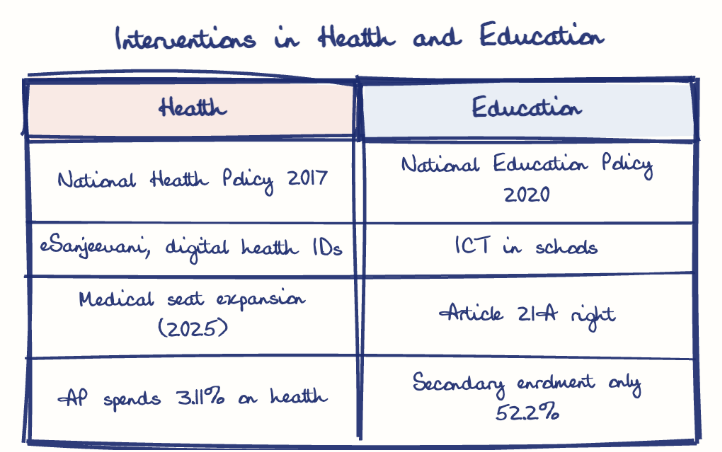
Major interventions in health and education include Article 21A's right to education, the National Education Policy 2020, the National Health Policy 2017, Centrally Sponsored Schemes and digital tools like eSanjeevani telemedicine. Gaps persist: Andhra Pradesh allocates only 3.11% of its budget to health against an 8% national target.
Model answer
Ghissu Editorial · Verified 4 Oct 2026 · 257 words
Constitutional and Policy Mandates
Article 21A ensures free education; Directive Principles promote health; NEP 2020 and NHP 2017 provide policy frameworks.
Infrastructure and HR Gaps
Audits reveal Andhra Pradesh has 22% specialist vacancies and insufficient community health centres4, limiting service quality.
Access and Quality Disparities
National secondary enrolment5 is 52.2%; Andhra Pradesh faces 44% Anganwadi centres lacking toilets and many unregistered construction workers, showing delivery gaps.
Health and Education Outcomes
Fertility rates decline and sanitation improves nationally, but Andhra Pradesh underperforms in health expenditure6 (3.11% budget vs. 8% target) and learning outcomes lag.
Digital Innovations and Fiscal Constraints
eSanjeevani telemedicine and NDHM health IDs enhance access; however, rural digital illiteracy and fiscal prioritization issues persist.
Monitoring and Capacity Building
Strengthening social audits and JAM trinity use can improve transparency; empowering local bodies in Andhra Pradesh will enhance last-mile delivery.
Public-Private Partnerships and Holistic Approaches
Responsible private sector involvement and integrating preventive health, nutrition, and education reforms can improve outcomes sustainably.
This model answer is indicative and the model can make mistakes; please verify key facts independently.
Practise this question
1Get the answer sheet
Sized for this question.
2Write your answer
Timed, by hand.
3Get it marked
Your score and what to fix.
This chapter in the exam
Government policies and interventions for development4 questions
Asked in 3 of 8 sittings since 2008
Most tested: Government intervention in social-sector development, especially education and health, with implementation issues.
- 2025Education is a vital sector for boosting the development of any nation. Highlight the recent developments in the education policy of the Indian government.
- 2025Although policies formulated by departments are prepared by experts, the results often fall short of expectations. What are the major issues responsible for this gap between policy formulation and implementation?
All 4 questions, sorted by sub-topic, with model answers and practice.
Question from the official APPSC Group-I Mains 2020 paper. Answer written by Ghissu's engine and checked against our editorial standards. Found an error? Tell us and we correct it within 48 hours.