Explain the role of Governor in states by focusing on its powers and functions.
In short
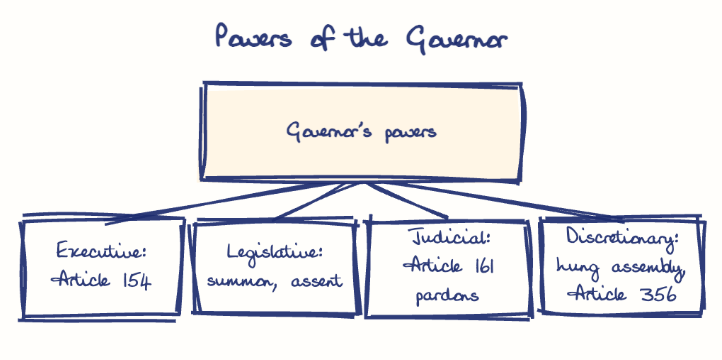
The Governor is the constitutional head of a state and the link between Centre and state, with executive, legislative, judicial (pardons under Article 161) and discretionary powers, such as choosing a Chief Minister in a hung assembly. The Bommai and Nabam Rebia judgments limit arbitrary use of these discretionary powers.
Model answer
Ghissu Editorial · Verified 4 Oct 2026 · 244 words
Executive and Legislative Authority
The Governor appoints the Chief Minister2, summons and dissolves the legislature, and must approve money bills, exemplified by Andhra Pradesh’s post-2014 administrative setup.
Judicial Powers and Constitutional Safeguards
Under Article 161, the Governor grants pardons and recommends President’s Rule (Article 356), with the S.R. Bommai case (1994) reinforcing limits on misuse.
Centre-State Link and Guardian of Constitution
Acting as the Centre’s representative, the Governor facilitates federal cooperation and ensures constitutional compliance, crucial during crises like President’s Rule imposition.
Discretionary Powers and Political Stability
The Governor’s discretion in hung assemblies, as tested in Karnataka in 2018, is key to government formation but can provoke Centre-State tensions, as seen in Kerala.
Judicial Oversight and Democratic Impact
Supreme Court rulings (Nabam Rebia 2016, S.R. Bommai 1994) curb arbitrary use of discretionary powers; misuse risks democratic erosion, evidenced by over 50 bills returned by Governors (2011-2021).
Fixed Tenure for Independence
Instituting fixed terms and secure tenure for Governors would reduce political interference and strengthen impartiality.
This model answer is indicative and the model can make mistakes; please verify key facts independently.
Practise this question
1Get the answer sheet
Sized for this question.
2Write your answer
Timed, by hand.
3Get it marked
Your score and what to fix.
This chapter in the exam
Federal structure, Governor and distribution of powers17 questions
Asked in 8 of 8 sittings since 2008
Most tested: Centre–State balance and the extent of Union supremacy over States
- 2025The procedure of enacting a law from a bill differs at the Union and State levels, primarily to safeguard the interests of the Union Government in state legislation. Elucidate this aspect.
- 2025Although States have their separate list for law-making, this authority is not beyond the overarching legislative powers of the Parliament. Examine.
All 17 questions, sorted by sub-topic, with model answers and practice.
Question from the official APPSC Group-I Mains 2020 paper. Answer written by Ghissu's engine and checked against our editorial standards. Found an error? Tell us and we correct it within 48 hours.