Define public debt and give its components with reference to Indian government? Explain trends in public debt since 2010 onwards.
In short
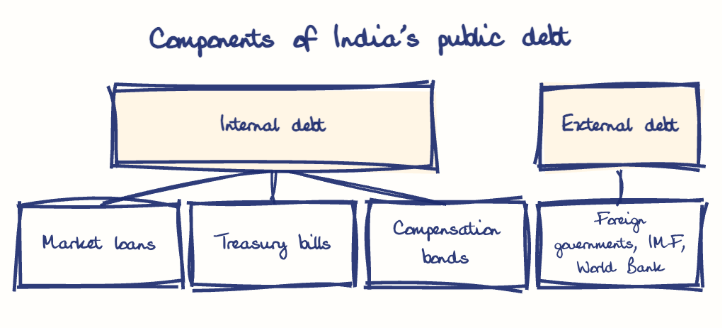
Public debt is government borrowing to cover spending beyond revenue, comprising internal debt (dated securities, treasury bills) and external debt from multilateral and bilateral lenders. Since 2010 it has grown, mostly internal, with maturity lengthening from 9.7 to 11.7 years, while Andhra Pradesh's liabilities reached 43.99% of GSDP in 2023.
Model answer
Ghissu Editorial · Verified 4 Oct 2026 · 266 words
Debt Management Role
RBI manages issuance and servicing but faces conflicts due to its monetary policy role; proposals for an independent debt management office aim to enhance efficiency.
State-Level Debt Challenges
Andhra Pradesh’s liabilities reached 43.99% of GSDP in 2023, with revenue deficits quadrupling in 2022-23 and capital expenditure falling sharply, straining fiscal health.
Fiscal Discipline Issues
States like Andhra Pradesh struggle with widening revenue deficits and governance lapses, as audits reveal ₹968 crore excess payments and 48% public account share, undermining debt sustainability.
Market Participation
Commercial banks dominate government securities holdings; foreign investor participation remains limited, affecting market depth.
Reforms Needed
Establishing an independent debt management office and strengthening fiscal discipline, especially in states, are critical for sustainable debt management.
This model answer is indicative and the model can make mistakes; please verify key facts independently.
Practise this question
1Get the answer sheet
Sized for this question.
2Write your answer
Timed, by hand.
3Get it marked
Your score and what to fix.
This chapter in the exam
Resource Mobilization in Indian Economy19 questions
Asked in 7 of 8 sittings since 2008
Most tested: Public debt and its sustainability in post-reform India.
- 2025Differentiate between internal and external public debt. Explain their relative advantages and risks for a developing country like India.
- 2025Discuss the key instruments of Monetary Policy (RBI) and Fiscal Policy in India and evaluate their role in resource mobilisation and inflation management.
All 19 questions, sorted by sub-topic, with model answers and practice.
Question from the official APPSC Group-I Mains 2020 paper. Answer written by Ghissu's engine and checked against our editorial standards. Found an error? Tell us and we correct it within 48 hours.