Discuss the initiatives taken by the Government of India to build smart cities, and highlight the challenges in doing so.
In short
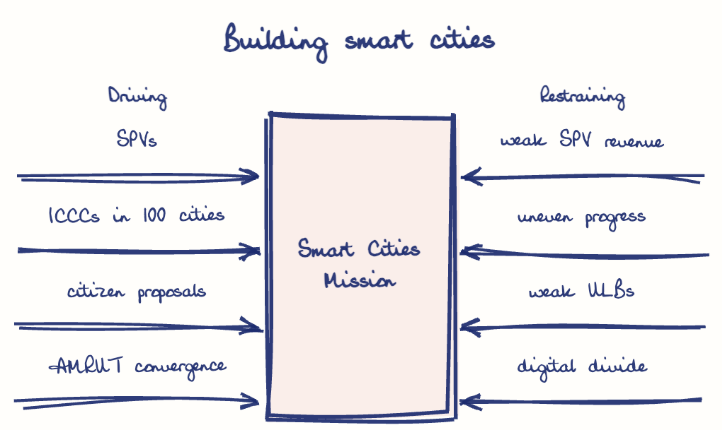
The Government of India launched the Smart Cities Mission in 2015 for 100 cities, using Special Purpose Vehicles, citizen-led proposals, links with AMRUT and Integrated Command and Control Centres in every city. Challenges include weak municipal finances and capacity, exclusion of the urban poor and poor waste management.
Model answer
Ghissu Editorial · Verified 4 Oct 2026 · 241 words
SPVs and Scheme Integration
Special Purpose Vehicles ensure local accountability; integration with AMRUT3 and DILRMP creates a coordinated urban development ecosystem.
Citizen Participation and State Issues
Participatory planning is encouraged, but Andhra Pradesh4’s CAG report highlights institutional weaknesses with 82 ULBs failing solid waste compliance.
Project Completion and Technology Use
94% of projects are complete nationally; all cities have Integrated Command Centres using AI and IoT, though utilisation and tech integration vary.
Social Inclusion and Financial Constraints
Benefits often favour affluent areas over informal settlements; many SPVs face revenue generation issues beyond government grants.
Waste and Utility Management
Andhra Pradesh’s ULBs process only 46% of collected waste, with legacy waste issues; smart meters improve resource efficiency.
Transport and Digital Governance
Cities like Visakhapatnam enhance connectivity via port-led corridors; e-governance platforms improve citizen services but digital divides persist.
Revenue and Capacity Building
Municipal bonds, land monetisation, and PPPs can boost finances; targeted training can strengthen ULBs.
Inclusive and Tech-Driven Development
Plans must address informal settlements; expand AI and IoT for sustainability and resilience.
This model answer is indicative and the model can make mistakes; please verify key facts independently.
Practise this question
1Get the answer sheet
Sized for this question.
2Write your answer
Timed, by hand.
3Get it marked
Your score and what to fix.
This chapter in the exam
Infrastructure in India10 questions
Asked in 4 of 8 sittings since 2008
Most tested: Public-private partnership: scope, problems, and restructuring.
- 2025Discuss the current state of transport infrastructure in India and its contribution to economic development. Highlight key challenges and suggest policy measures for improving its efficiency and reach.
- 2025Discuss the significance of solar energy in India's renewable energy strategy. Highlight the major initiatives, achievements and challenges in the promotion of solar power.
All 10 questions, sorted by sub-topic, with model answers and practice.
Question from the official APPSC Group-I Mains 2020 paper. Answer written by Ghissu's engine and checked against our editorial standards. Found an error? Tell us and we correct it within 48 hours.