Discuss the significance of solar energy in India's renewable energy strategy. Highlight the major initiatives, achievements and challenges in the promotion of solar power.
In short
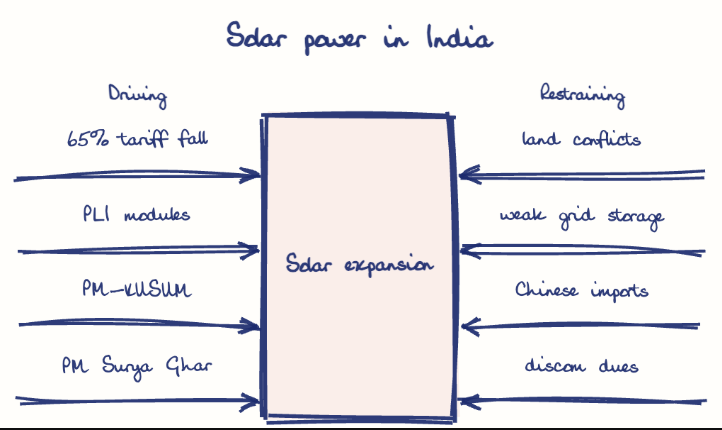
Solar energy is central to India's renewable strategy because it offers abundant, increasingly cheap clean power for energy security and climate goals, backed by the National Solar Mission, solar parks, PM Surya Ghar, PM-KUSUM and PLI. Tariffs fell nearly 65% in a decade, but land, storage and imports remain challenges.
Model answer
Ghissu Editorial · Verified 4 Oct 2026 · 240 words
Manufacturing and Financial Barriers
Domestic solar module capacity doubled to 74 GW, yet import dependence remains, particularly on China. Financial issues and discom delays affect schemes like PM Surya Ghar Muft Bijli Yojana, limiting small-scale adoption despite subsidies.
Cost and Livelihood Benefits
Solar tariffs fell 65%, making solar competitive; PM-KUSUM4’s solar irrigation pumps in Andhra Pradesh boost agriculture and reduce diesel use, enhancing rural livelihoods and energy access.
Employment and Climate Goals
PLI schemes enhance manufacturing and jobs, supporting India’s NDC to cut emission intensity by 45% by 2030. Solar energy also advances sustainable development and energy security.
This model answer is indicative and the model can make mistakes; please verify key facts independently.
Practise this question
1Get the answer sheet
Sized for this question.
2Write your answer
Timed, by hand.
3Get it marked
Your score and what to fix.
This chapter in the exam
Infrastructure in India10 questions
Asked in 4 of 8 sittings since 2008
Most tested: Public-private partnership: scope, problems, and restructuring.
- 2025Discuss the current state of transport infrastructure in India and its contribution to economic development. Highlight key challenges and suggest policy measures for improving its efficiency and reach.
- 2025Critically evaluate the role of the Smart Cities Mission in transforming urban infrastructure in India. Mention its objectives, implementation progress, key achievements and the major challenges faced.
All 10 questions, sorted by sub-topic, with model answers and practice.
Question from the official APPSC Group-I Mains 2025 paper. Answer written by Ghissu's engine and checked against our editorial standards. Found an error? Tell us and we correct it within 48 hours.