Discuss the current state of transport infrastructure in India and its contribution to economic development. Highlight key challenges and suggest policy measures for improving its efficiency and reach.
In short
India's transport infrastructure is expanding fast under PM GatiShakti and a capital outlay above Rs 11 lakh crore for FY26, boosting productivity and trade, but roads dominate freight while rail and waterways stay underused. Key fixes are multimodal integration, better maintenance and safety, greener modes and stronger PPP capacity.
Model answer
Ghissu Editorial · Verified 4 Oct 2026 · 270 words
Coordinated Policy
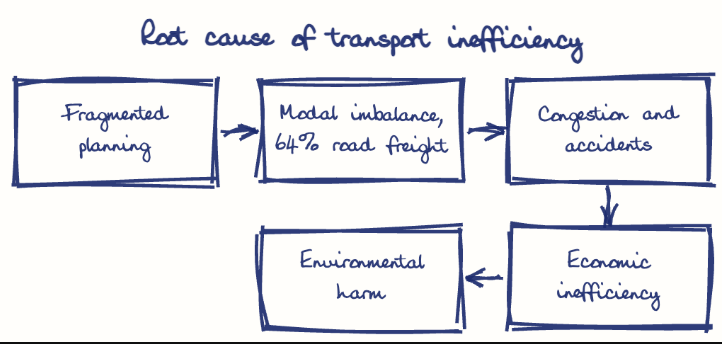
PM GatiShakti integrates railways, roads, ports, waterways, and logistics, addressing fragmented planning to boost multimodal transport.
State Implementation
Andhra Pradesh3’s focus on port-led industrial corridors such as Visakhapatnam-Chennai exemplifies regional alignment with national infrastructure goals.
Investment Mechanisms
PPP models, hybrid annuity, and NIIF mobilize private capital to overcome fiscal constraints and improve project execution.
Regulatory Systems
GST integration and dispute resolution streamline interstate freight movement and project delivery.
Modal Imbalance
Roadways dominate freight transport with over 64% share, causing congestion; railways and inland waterways4 are underutilized despite environmental advantages.
Delivery and Reach Gaps
Land acquisition delays and limited technical capacity slow projects, while rural and last-mile connectivity remains uneven.
Energy Sustainability
Transport consumes 18% of commercial energy and 55% of petroleum, raising environmental and energy security concerns.
Multimodal Integration
Schemes like SMILE and National Logistics Policy aim to link ports, railways, and roads, reducing logistics costs.
Maintenance and Safety
Adopt advanced safety standards and pre-emptive maintenance using technology to improve infrastructure longevity.
Sustainable Transport
Promote railway electrification, inland waterways, and coastal shipping to cut carbon emissions and petroleum dependence.
Institutional Capacity
Enhance government expertise in PPPs, simplify clearances, and ensure transparent regulations to attract investment.
This model answer is indicative and the model can make mistakes; please verify key facts independently.
Practise this question
1Get the answer sheet
Sized for this question.
2Write your answer
Timed, by hand.
3Get it marked
Your score and what to fix.
This chapter in the exam
Infrastructure in India10 questions
Asked in 4 of 8 sittings since 2008
Most tested: Public-private partnership: scope, problems, and restructuring.
- 2025Discuss the significance of solar energy in India's renewable energy strategy. Highlight the major initiatives, achievements and challenges in the promotion of solar power.
- 2025Critically evaluate the role of the Smart Cities Mission in transforming urban infrastructure in India. Mention its objectives, implementation progress, key achievements and the major challenges faced.
All 10 questions, sorted by sub-topic, with model answers and practice.
Question from the official APPSC Group-I Mains 2025 paper. Answer written by Ghissu's engine and checked against our editorial standards. Found an error? Tell us and we correct it within 48 hours.