Explain the Marginal Cost Pricing Rule for Public Utilities. What are the problems associated with this rule?
In short
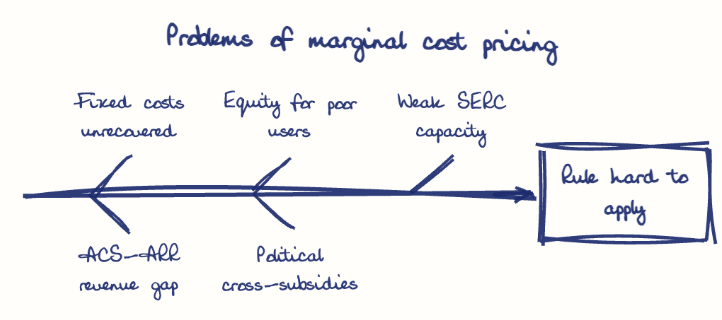
The marginal cost pricing rule sets a public utility's price equal to the cost of supplying one more unit, which is allocatively efficient in theory. Its problems are losses for utilities with high fixed and falling average costs, equity concerns for poor consumers, cost measurement difficulties and political pressure.
Model answer
Ghissu Editorial · Verified 4 Oct 2026 · 273 words
Electricity (Amendment) Bill1, 2025
Modernises power regulation by promoting cost-reflective tariffs and empowering SERCs, but overlapping jurisdictions complicate enforcement and regulatory independence.
Penalty Imposition Weakness
Despite rules like the Electricity (Rights of Consumers) Amendment Rules, 2023, penalties are rare, weakening compliance incentives. This undermines efforts to enforce Renewable Purchase Obligations and cost-based pricing norms.
Fixed vs. Variable Costs
Utilities face fixed costs not covered by marginal pricing, disrupting cash flows and investments in Andhra Pradesh. This mismatch hinders capacity expansion and renewable energy integration.
Equity Concerns
Strict marginal cost pricing risks higher tariffs for low-income consumers, problematic in rural Andhra Pradesh reliant on subsidies. Political pressures for subsidised power distort tariff structures, limiting regulator autonomy.
Administrative Capacity
SERCs in Andhra Pradesh face staff shortages and data gaps, impeding cost-reflective tariff enforcement and transparency, which are critical for effective marginal cost pricing.
Gradual Tariff Reforms
Phase in marginal cost pricing with targeted subsidies to protect vulnerable groups, balancing efficiency with social equity in Andhra Pradesh’s power sector2.
This model answer is indicative and the model can make mistakes; please verify key facts independently.
Practise this question
1Get the answer sheet
Sized for this question.
2Write your answer
Timed, by hand.
3Get it marked
Your score and what to fix.
This chapter in the exam
Infrastructure in India10 questions
Asked in 4 of 8 sittings since 2008
Most tested: Public-private partnership: scope, problems, and restructuring.
- 2025Discuss the current state of transport infrastructure in India and its contribution to economic development. Highlight key challenges and suggest policy measures for improving its efficiency and reach.
- 2025Discuss the significance of solar energy in India's renewable energy strategy. Highlight the major initiatives, achievements and challenges in the promotion of solar power.
All 10 questions, sorted by sub-topic, with model answers and practice.
Question from the official APPSC Group-I Mains 2020 paper. Answer written by Ghissu's engine and checked against our editorial standards. Found an error? Tell us and we correct it within 48 hours.