In the light of the problems faced by public-private partnerships in India, give recommendations on the future plan of action.
In short
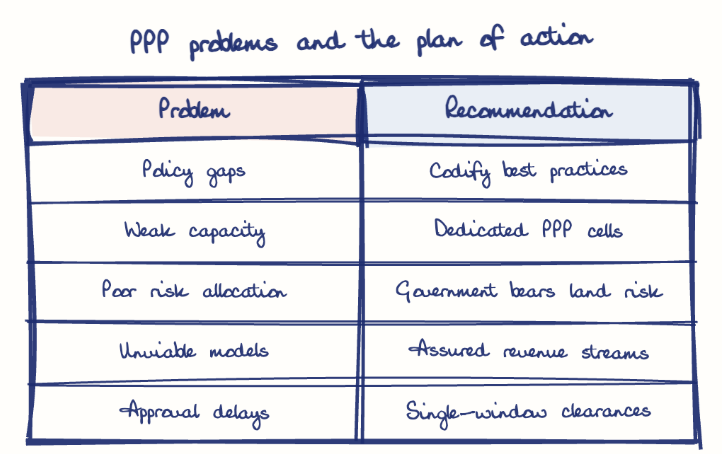
PPPs in India suffer from unclear policy, weak agency capacity, poor risk allocation, unviable revenue models and land and approval delays, so the future plan needs dedicated PPP cells, clear risk-sharing, viability gap funding and digital monitoring. Platforms like PRAGATI can track projects in real time and speed interventions.
Model answer
Ghissu Editorial · Verified 4 Oct 2026 · 246 words
Policy and Governance
Andhra Pradesh’s SPSEs, accounting for 6.69% of GSDP, face governance and arrears issues, underscoring the need for unified PPP policies and dedicated cells for capacity building. Establishing specialized PPP cells with trained professionals can enhance project appraisal and risk management.
Project Viability and Execution
Aggressive bidding on optimistic traffic forecasts stalled many highway BOT projects, reflecting poor revenue models and land acquisition delays; streamlining approvals via digital platforms like PM GatiShakti is essential. Clearer risk allocation, especially shifting land and regulatory risks to the public sector, can improve project delivery.
Institutionalizing Best Practices
Codifying risk-sharing frameworks in state legislation will boost investor confidence. Andhra Pradesh should also adopt successful PPP models from sectors like roads to standardize contracts and dispute resolution.
Capacity Building and Technology
Training officials and integrating digital project management platforms will improve PPP outcomes. Regular capacity-building programs will strengthen contract management and reduce implementation delays.
This model answer is indicative and the model can make mistakes; please verify key facts independently.
Practise this question
1Get the answer sheet
Sized for this question.
2Write your answer
Timed, by hand.
3Get it marked
Your score and what to fix.
This chapter in the exam
Infrastructure in India10 questions
Asked in 4 of 8 sittings since 2008
Most tested: Public-private partnership: scope, problems, and restructuring.
- 2025Discuss the current state of transport infrastructure in India and its contribution to economic development. Highlight key challenges and suggest policy measures for improving its efficiency and reach.
- 2025Discuss the significance of solar energy in India's renewable energy strategy. Highlight the major initiatives, achievements and challenges in the promotion of solar power.
All 10 questions, sorted by sub-topic, with model answers and practice.
Question from the official APPSC Group-I Mains 2020 paper. Answer written by Ghissu's engine and checked against our editorial standards. Found an error? Tell us and we correct it within 48 hours.