What are the factors responsible for the narrow tax base in India? Explain in brief.
In short
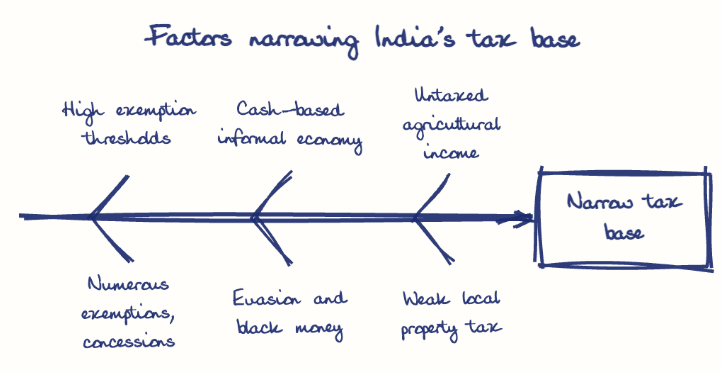
India's tax base is narrow because of high exemption thresholds, numerous concessions, a large informal cash economy, untaxed agricultural income and weak tax administration. Only about 4% of the voting-age population pays taxes, and Andhra Pradesh's 2021-22 CAG audit found revenue losses of over ₹1,800 crore.
Model answer
Ghissu Editorial · Verified 4 Oct 2026 · 298 words
High Exemption Thresholds
Making income up to ₹12 lakh4 effectively tax-free under the new regime excludes many taxpayers, shrinking the tax base and reducing direct tax revenues despite rising incomes.
Tax Administration Gaps
The Andhra Pradesh CAG audit (2021-22) found ₹1,806 crore revenue losses in tax and land departments due to enforcement weaknesses and underassessment, highlighting institutional inefficiencies.
Informal Economy and Revenue Shortfalls
Large informal sector and cash transactions cause evasion; Andhra Pradesh Mining Revenue5 shows 16% shortfalls and data gaps, reflecting difficulties in formalising economic activities.
Low Taxpayer Penetration
Only 4% of voting-age Indians pay taxes, far below the 23% expected based on political development, limiting revenue mobilisation and fiscal capacity.
Excessive Reliance on Indirect Taxes
Heavy dependence on indirect taxes reduces progressivity and voluntary compliance, weakening the link between taxpayers and the state.
Local Government Empowerment
Enhancing local taxation powers and property tax collection, including in Andhra Pradesh, can boost subnational revenues and fiscal decentralisation.
This model answer is indicative and the model can make mistakes; please verify key facts independently.
Practise this question
1Get the answer sheet
Sized for this question.
2Write your answer
Timed, by hand.
3Get it marked
Your score and what to fix.
This chapter in the exam
Resource Mobilization in Indian Economy19 questions
Asked in 7 of 8 sittings since 2008
Most tested: Public debt and its sustainability in post-reform India.
- 2025Differentiate between internal and external public debt. Explain their relative advantages and risks for a developing country like India.
- 2025Discuss the key instruments of Monetary Policy (RBI) and Fiscal Policy in India and evaluate their role in resource mobilisation and inflation management.
All 19 questions, sorted by sub-topic, with model answers and practice.
Question from the official APPSC Group-I Mains 2020 paper. Answer written by Ghissu's engine and checked against our editorial standards. Found an error? Tell us and we correct it within 48 hours.