In October 2020, the Nobel Prize for Chemistry was awarded to the CRISPR technology. Explain how CRISPR functions in nature and how it has been adapted for research and clinical applications.
In short
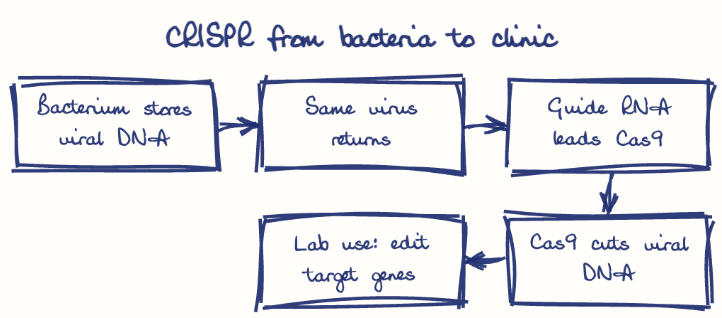
In nature, CRISPR is a bacterial immune memory in which stored viral DNA yields guide RNA that directs the Cas9 enzyme to cut matching viral DNA. Doudna and Charpentier turned it into a programmable editing tool, now used in gene therapy like Casgevy (2023), diagnostics and genome-edited rice.
Model answer
Ghissu Editorial · Verified 4 Oct 2026 · 249 words
Bacterial Adaptive Immunity
CRISPR stores viral DNA snippets as genetic memory; guide RNA directs Cas9 to cut matching viral DNA, disabling viruses.
Nobel Recognition
Jennifer Doudna and Emmanuelle Charpentier’s 2012 discovery of CRISPR-Cas9’s mechanism led to its gene-editing adaptation and the 2020 Nobel Prize.
Gene Editing Precision
Synthetic guide RNAs enable targeted DNA edits in humans, animals, and plants faster and cheaper than previous methods.
Medical and Diagnostic Advances
CRISPR treats genetic diseases like sickle cell anemia and cancer; Tata Memorial Hospital’s RAPID-CRISPR test for Acute Promyelocytic Leukemia exemplifies diagnostic use.
Agricultural Benefits in Andhra Pradesh
India’s first genome-edited rice varieties, released by ICAR in 2025 with higher yield and stress tolerance, suit drought-prone regions like Rayalaseema, enhancing food security.
Environmental Biotechnology
CRISPR-engineered microbes improve biofuel production; gene drives target malaria mosquitoes, raising ethical concerns.
Ethical and Regulatory Gaps
Cases like 2018 gene-edited babies in China highlight the need for India’s clear CRISPR guidelines.
Access and Infrastructure
High costs and India’s 0.65% GDP R&D spending limit CRISPR scaling; boosting biotech hubs in Andhra Pradesh, such as around Visakhapatnam, is vital.
This model answer is indicative and the model can make mistakes; please verify key facts independently.
Practise this question
1Get the answer sheet
Sized for this question.
2Write your answer
Timed, by hand.
3Get it marked
Your score and what to fix.
This chapter in the exam
Biotechnology & Nanotechnology: scope, ethics, genetic engineering, biodiversity, fermentation, immuno-diagnosis50 questions
Asked in 8 of 8 sittings since 2008
Most tested: Biodiversity and biotechnology governance/ethics, especially conservation, GMOs, and applied public-health biotech.
- 2025Trace the evolution of India's National Biotechnology Development Strategy (NBDS) and discuss its key objectives. Critically evaluate its impact on the growth of the biotechnology sector in India.
- 2025Analyze the potential of plant-derived biopharmaceuticals in promoting sustainable healthcare. Explain how the application of green pharmacy principles can help minimize environmental harm at each stage of the pharmaceutical lifecycle.
All 50 questions, sorted by sub-topic, with model answers and practice.
Question from the official APPSC Group-I Mains 2020 paper. Answer written by Ghissu's engine and checked against our editorial standards. Found an error? Tell us and we correct it within 48 hours.