What are the most common and hazardous pollutants in outdoor and indoor air? Mention the health hazards from each of the pollutants. What is AQI (Air Quality Index)? Who monitors AQI in India? What is the contribution of PM to AQI?
In short
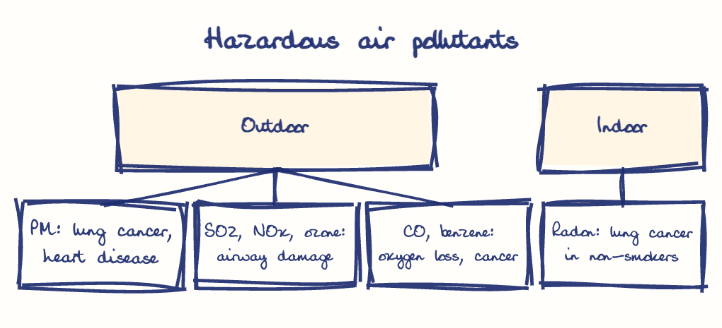
Common hazardous air pollutants are PM2.5 and PM10 (lung and heart disease), SO2 and NOx (airway damage), ozone, carbon monoxide (oxygen deprivation), benzene (cancer) and indoor radon (lung cancer). The AQI, launched in 2015 and monitored by the CPCB, rates eight pollutants, and PM usually sets the overall index.
Model answer
Ghissu Editorial · Verified 4 Oct 2026 · 288 words
Particulate Matter (PM2.5 and PM10)
These fine particles cause respiratory infections, lung cancer, heart disease, and premature death, dominating AQI pollution levels.
Gaseous Pollutants
SO2 from industries causes bronchitis; NOx from vehicles inflames airways and forms smog; O3 worsens asthma; CO from incomplete combustion impairs oxygen transport; benzene causes blood disorders; radon gas indoors leads to lung cancer.
CPCB and AQI System
CPCB enforces National Ambient Air Quality Standards and launched AQI in 2015 under Swachh Bharat Mission, monitoring eight pollutants nationwide.
State and Local Roles
State Pollution Control Boards and local bodies, including Andhra Pradesh2 urban local bodies with waste management audit gaps (2022), implement monitoring and control measures.
PM Dominance
PM2.5 and PM10 are major AQI contributors, often exceeding safe limits and causing severe pollution episodes.
Monitoring and Data Gaps
Many cities, including those in Andhra Pradesh, lack comprehensive real-time data, limiting public awareness and policy response.
Indoor Pollution Neglect
Radon and biomass fuel emissions indoors remain under-monitored, causing health burdens.
Expand Monitoring
Upgrade AQI infrastructure in Andhra Pradesh and other states with advanced sensors and real-time data.
Integrate Indoor Air Quality
Address radon and biomass fuel pollution in policy frameworks.
This model answer is indicative and the model can make mistakes; please verify key facts independently.
Practise this question
1Get the answer sheet
Sized for this question.
2Write your answer
Timed, by hand.
3Get it marked
Your score and what to fix.
This chapter in the exam
Pollution & solid waste; global issues; environmental legislation; disaster management policy; agricultural revolutions43 questions
Asked in 8 of 8 sittings since 2008
Most tested: Solid waste management and pollution-control legislation
- 2025What are the key principles of Integrated Solid Waste Management (ISWM)? Discuss the role of waste hierarchy in ISWM.
- 2025Define global warming, and differentiate it clearly from climate change. Explain the key natural and human-induced causes of global warming and briefly discuss which factors are currently dominant in driving global temperature rise.
All 43 questions, sorted by sub-topic, with model answers and practice.
Question from the official APPSC Group-I Mains 2020 paper. Answer written by Ghissu's engine and checked against our editorial standards. Found an error? Tell us and we correct it within 48 hours.