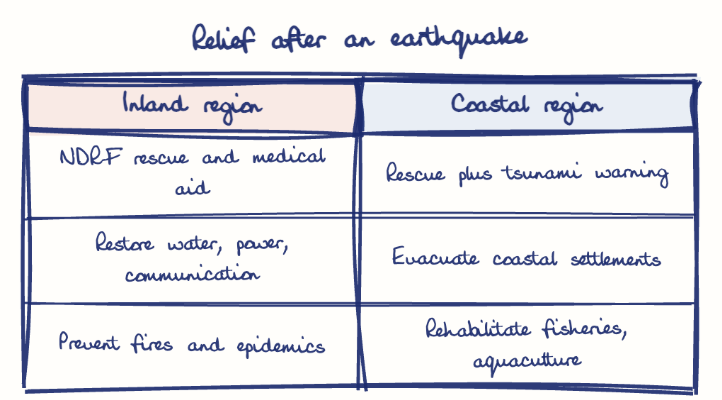
What causes earthquakes? Can we prevent or predict where and when an earthquake will happen? What should relief agencies do after an earthquake occurs in an inland and a coastal region?
In short
Earthquakes are caused mainly by sudden release of stress along faults and plate boundaries, and also by volcanoes, reservoirs and mining. They cannot be prevented or precisely predicted, so relief must pair rescue and restored services inland with tsunami warning, evacuation and fisheries rehabilitation on the coast.
Model answer
Ghissu Editorial · Verified 4 Oct 2026 · 268 words
Tectonic Plate Movements
Earthquakes mainly arise from plate boundary stresses, exemplified by the 2011 Japan quake; reservoir-induced seismicity, as in the 1967 Koyna event, shows anthropogenic triggers.
No Prevention, Limited Prediction
Earthquakes cannot be prevented; precise prediction is not yet possible despite enhanced seismic monitoring (168 observatories by 2025). GPS technology aids in tracking tectonic shifts but falls short of forecasting exact events.
Risk Zoning and Early Warning
India’s earthquake hazard maps and vulnerability assessments, including for Andhra Pradesh, guide preparedness; early warning systems offer limited advance notice. Public education complements these efforts to improve response readiness.
Coastal Specifics
Tsunami risks require evacuation plans and fisheries rehabilitation, vital for Andhra Pradesh’s coastal economy. Dissemination of tsunami warnings and community drills enhance coastal resilience.
Seismic Monitoring and Building Codes
Expand seismic observatories and enforce National Building Code for earthquake resilience in Andhra Pradesh. Incorporating earthquake-resistant designs reduces structural vulnerability.
Community Capacity Building
Enhance disaster preparedness training and public awareness for sustained resilience. Lessons from Gujarat’s 2001 earthquake emphasize community involvement in disaster management.
This model answer is indicative and the model can make mistakes; please verify key facts independently.
Sources
Practise this question
1Get the answer sheet
Sized for this question.
2Write your answer
Timed, by hand.
3Get it marked
Your score and what to fix.
This chapter in the exam
Development vs Environment: natural resources, climate change, EIA, natural disasters48 questions
Asked in 8 of 8 sittings since 2008
Most tested: Climate change and mining/environmental degradation links
- 2025Explain the different types of natural resources in India. How are they being conserved through government initiatives?
- 2025Investigate the relationship between mining activities and the occurrence of earthquakes. Explain how mining operations can be regulated to minimize seismic risks.
All 48 questions, sorted by sub-topic, with model answers and practice.
Question from the official APPSC Group-I Mains 2020 paper. Answer written by Ghissu's engine and checked against our editorial standards. Found an error? Tell us and we correct it within 48 hours.