What is the status of utilization of Solar energy in India and the World? What are some factors hindering utilization of this green energy source?
In short
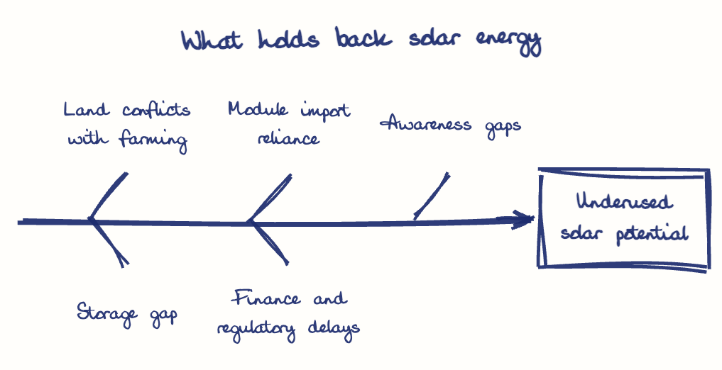
Solar energy is expanding fast worldwide, with global capacity of about 1,800 GW by end-2024 led by China, and India ranks third. Its use is hindered by land conflicts, thin storage (about 5.5 GW), import dependence on Chinese modules and financing gaps for rooftop systems.
Model answer
Ghissu Editorial · Verified 4 Oct 2026 · 273 words
Policy and Schemes
PM Surya Ghar Yojana and PM-KUSUM provide subsidies and infrastructure, with PM Surya Ghar crossing about 6.3 lakh rooftop installations nationally in its first year, Andhra Pradesh included. The Rooftop Solar Programme promotes urban and rural solar use, addressing energy access and sustainability.
Manufacturing and Alliances
The PLI scheme increased solar module capacity from 38 GW to 74 GW (2024-25), reducing imports; India leads the International Solar Alliance for global cooperation and technology sharing, enhancing diplomatic influence in clean energy.
Land and Grid Issues
Land acquisition conflicts delay projects; Andhra Pradesh reflects national trends with environmental and agricultural concerns. Storage capacity (5.5 GW) is far below the 61 GW needed by 2030, limiting solar’s reliability and round-the-clock supply.
Manufacturing and Awareness
Expand domestic production of raw materials like polysilicon; increase subsidies, affordable loans, and targeted outreach campaigns, especially in Andhra Pradesh, to boost rooftop solar adoption and public acceptance.
This model answer is indicative and the model can make mistakes; please verify key facts independently.
Practise this question
1Get the answer sheet
Sized for this question.
2Write your answer
Timed, by hand.
3Get it marked
Your score and what to fix.
This chapter in the exam
Energy: needs, resources, policy; Nuclear programme and policy24 questions
Asked in 8 of 8 sittings since 2008
Most tested: Renewable energy transition in India, especially solar/clean energy and barriers to large-scale adoption.
- 2025Differentiate between conventional and non-conventional energy resources. Explain their relevance in India's energy sector.
- 2023What is the current scenario of renewable power generation in India ? Discuss the factors responsible for the growing focus and shift towards Renewable energy.
All 24 questions, sorted by sub-topic, with model answers and practice.
Question from the official APPSC Group-I Mains 2020 paper. Answer written by Ghissu's engine and checked against our editorial standards. Found an error? Tell us and we correct it within 48 hours.