Write a brief account of the history of ISRO. Name any three ISRO centers and their location. Add a note about the Mangalyaan or Chandrayaan missions of ISRO.
In short
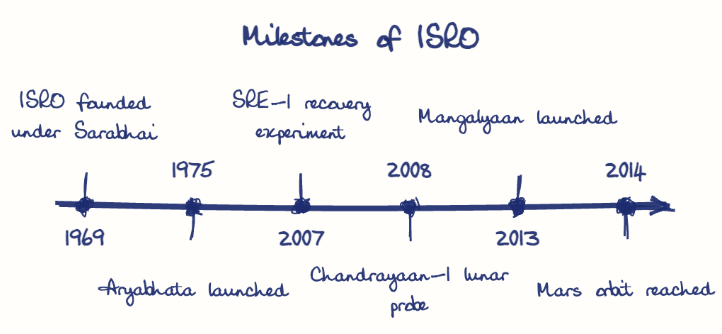
ISRO, founded in 1969 under Vikram Sarabhai, grew from the Aryabhata satellite of 1975 to the PSLV and GSLV launchers, with key centres at VSSC Thiruvananthapuram, URSC Bengaluru and SDSC Sriharikota in Andhra Pradesh. Chandrayaan-1 (2008) found water molecules on the Moon, and Mangalyaan reached Mars orbit in 2014.
Model answer
Ghissu Editorial · Verified 4 Oct 2026 · 264 words
Founding and Early Progress
ISRO was founded by Dr. Vikram Sarabhai with a vision to use space technology for national development. The launch of Aryabhata in 1975 marked India’s entry into space.
Key Centres
Vikram Sarabhai Space Centre (Thiruvananthapuram) focuses on launch vehicle development; U R Rao Satellite Centre (Bengaluru) is responsible for satellite design and integration; Satish Dhawan Space Centre (Sriharikota, Andhra Pradesh) serves as the primary launch site for ISRO’s missions.
Chandrayaan Missions
Chandrayaan-1, launched in 2008 from Sriharikota, was India’s first lunar probe and discovered water molecules on the moon’s surface. Chandrayaan-2, launched in 2019, carried eight scientific instruments to study lunar mineralogy and evolution, advancing India’s lunar exploration.
Mangalyaan
Launched in 2013, the Mars Orbiter Mission1 successfully entered Mars orbit in 2014. It demonstrated India’s ability to conduct cost-effective interplanetary missions, achieving this feat at a fraction of the cost of similar missions by other countries.
Space Science Expansion
Increasing investment in planetary exploration and space science missions will help ISRO maintain its global competitiveness and technological edge.
This model answer is indicative and the model can make mistakes; please verify key facts independently.
Sources
Practise this question
1Get the answer sheet
Sized for this question.
2Write your answer
Timed, by hand.
3Get it marked
Your score and what to fix.
This chapter in the exam
Indian Space Programme, ISRO, Satellites and DRDO23 questions
Asked in 8 of 8 sittings since 2008
Most tested: Remote sensing and satellite applications for agriculture, natural resources, and rural development.
- 2025Describe the role of the Indian Remote Sensing (IRS) satellite programme. How do these satellites assist in natural resource management?
- 2025Discuss the vision and mission of DRDO? Describe the role of DRDO in the contribution to national development.
All 23 questions, sorted by sub-topic, with model answers and practice.
Question from the official APPSC Group-I Mains 2020 paper. Answer written by Ghissu's engine and checked against our editorial standards. Found an error? Tell us and we correct it within 48 hours.