Assess the socio-religious reform movements in the Muslim community during the 19th century. Discuss the contributions made by Sayyid Ahmad Khan towards the upliftment of the Muslim community.
In short
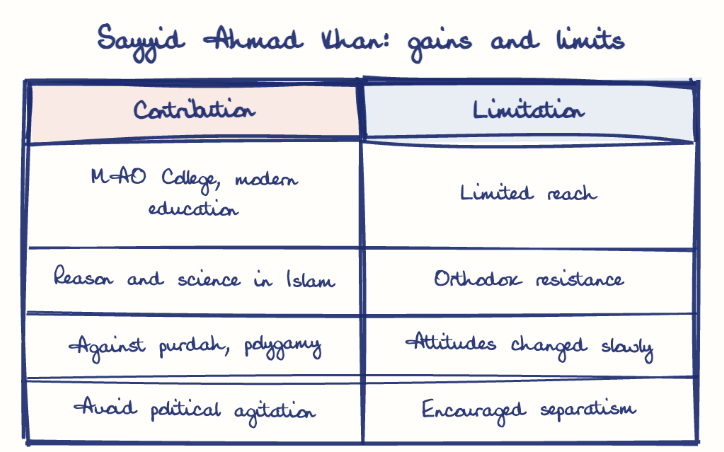
Nineteenth-century Muslim reform movements emerged late, after 1857, reconciling Islam with rationalism and modern education and attacking purdah, polygamy and child marriage, though their political caution sometimes fed separatism. Sayyid Ahmad Khan founded the Muhammadan Anglo-Oriental College (later Aligarh Muslim University) and promoted a rational reading of Islam through Tahzib-ul-Akhlaq.
Model answer
Ghissu Editorial · Verified 4 Oct 2026 · 294 words
Rationalism and Education Focus
Reformers emphasized reconciling Islam with modern science; Sayyid Ahmad Khan founded the Muhammadan Anglo-Oriental College, fostering a new Muslim intelligentsia. They challenged blind traditionalism and promoted critical thinking to uplift the community intellectually and socially.
Modern Education Pioneer
He established the Muhammadan Anglo-Oriental College (later Aligarh Muslim University), promoting Western-style education among Muslims. This institution became a hub for modern learning and Muslim socio-political awakening.
Social Reform1 Advocacy
Through Tahzib-ul-Akhlaq he criticised superstition, polygamy and wasteful customs, though he was cautious on women’s education, seeking to modernize Muslim society while preserving Islamic identity.
Political Moderation
Urged Muslims to focus on education over political agitation, a stance criticized for encouraging communal separatism and delaying Muslim participation in the nationalist movement.
Inclusive Education and Empowerment
Expand quality education across all Muslim social strata and enhance women’s socio-economic participation to overcome historical backwardness.
Promote Interfaith Dialogue
Encourage tolerance and broadmindedness to counter communal divisions partly rooted in reformist separatism.
Encourage Political Engagement
Foster active Muslim participation in democratic processes to ensure equitable representation and integration.
This model answer is indicative and the model can make mistakes; please verify key facts independently.
Sources
Practise this question
1Get the answer sheet
Sized for this question.
2Write your answer
Timed, by hand.
3Get it marked
Your score and what to fix.
This chapter in the exam
British Rule 1757-1856, the 1857 Revolt, Socio-Religious Reform & the Rise of Nationalism20 questions
Asked in 8 of 8 sittings since 2008
Most tested: Colonialism’s impact on Indian society/economy and reform-led social uplift, especially untouchability and caste reform.
- 2025What do you understand by the Permanent Settlement, and what impact did it have on Indian society? Comment.
- 2025What do you understand by the 'safety valve' theory? Explain it in the context of the Indian National Congress?
All 20 questions, sorted by sub-topic, with model answers and practice.
Question from the official APPSC Group-I Mains 2023 paper. Answer written by Ghissu's engine and checked against our editorial standards. Found an error? Tell us and we correct it within 48 hours.