Examine the manner in which the Chola village administration had contributed to the growth of village autonomy as indicated by the Uttaramerur/Uttaramallur inscriptions.
In short
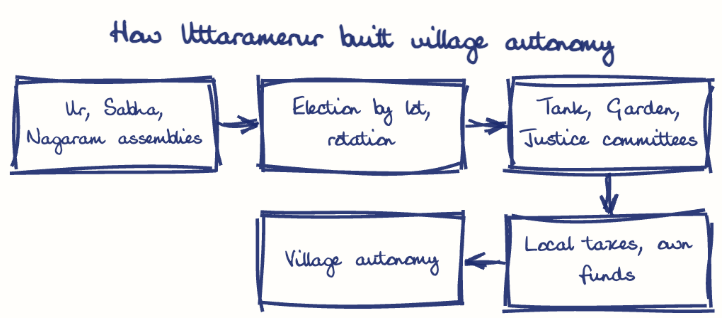
The Uttaramerur inscriptions of Parantaka I show Chola village assemblies (Ur, Sabha and Nagaram) governing through specialised committees, officials chosen by lot for one-year terms, and local control of tanks, disputes and taxes. This rotation, committee system and fiscal independence fostered genuine village autonomy with minimal royal interference.
Model answer
Ghissu Editorial · Verified 4 Oct 2026 · 279 words
Multiple Assemblies
Ur (general), Sabha (Brahmin), and Nagaram (merchant) assemblies ensured representation of varied social groups, reflecting inclusive governance that balanced caste and occupational interests.
Electoral and Rotational System
Officials were selected by lot from property-owning, educated men for one-year terms, with a three-year bar on re-election, preventing elite dominance and promoting accountability through regular rotation.
Decentralized Decision-Making2
Committees like the Tank and Justice Committees managed local resources and disputes, reducing state interference and enabling villages to regulate irrigation, land, and justice independently.
Detailed Electoral Procedures
Inscriptions specify candidate qualifications, lot-drawing, and tenure, reflecting democratic governance and a transparent selection process that minimized corruption.
Financial Autonomy
Villages levied taxes and raised loans for public works such as tank construction, with funds kept separate from state revenue, underscoring fiscal independence and economic self-sufficiency.
Revive Electoral Traditions
Adopting participatory, rotational leadership can enhance Panchayati Raj democracy by preventing power concentration and encouraging wider community involvement.
Strengthen Committees
Institutionalizing resource and dispute management committees can boost local autonomy and improve efficiency in governance, drawing lessons from Chola functional specialization.
This model answer is indicative and the model can make mistakes; please verify key facts independently.
Practise this question
1Get the answer sheet
Sized for this question.
2Write your answer
Timed, by hand.
3Get it marked
Your score and what to fix.
This chapter in the exam
Early Medieval & Medieval India - Pallavas to Cholas, Delhi Sultanate, Bhakti & Sufi, Kakatiya-Vijayanagara-Bahmani-Qutubshahi13 questions
Asked in 8 of 8 sittings since 2008
Most tested: Medieval cultural history through Bhakti/Sufi and South Indian dynastic contributions to religion, architecture, and social organization.
- 2025Describe the contributions of the Chalukya rulers of Kalyani in the fields of sculpture, architecture, and literature.
- 2025Describe the characteristics of the Sufi movement and assess its impact on Indian culture.
All 13 questions, sorted by sub-topic, with model answers and practice.
Question from the official APPSC Group-I Mains 2023 paper. Answer written by Ghissu's engine and checked against our editorial standards. Found an error? Tell us and we correct it within 48 hours.