Explain Alauddin Khilji's market regulations and discuss their impact.
In short
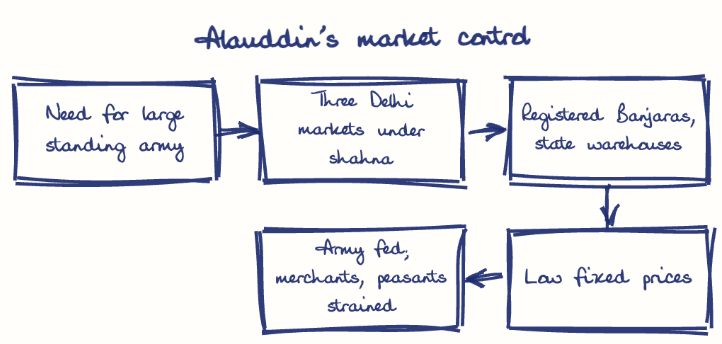
Alauddin Khilji set up three regulated markets in Delhi under shahnas, fixed prices, registered merchants and banjaras, stored grain and collected revenue directly to feed a large army against Mongol threats. Prices stayed low for soldiers and townspeople, but peasants paying up to half their produce bore the strain.
Model answer
Ghissu Editorial · Verified 4 Oct 2026 · 266 words
Centralized Market Control
Alauddin established three specialized markets in Delhi, each overseen by shahnas who enforced price controls and maintained merchant registers.
Direct State Revenue Collection
He mandated direct land revenue collection in the doab, assessed through precise land measurement to prevent elite exploitation.
Strict Official Oversight
Amils and local officials received adequate salaries but faced audits and harsh punishments for corruption, enhancing accountability.
Anti-Hoarding Measures
Banjaras were registered and held collectively responsible for price violations; state warehouses ensured foodgrain supply during shortages.
Merchant Resistance and Benefits
Hindu merchants resisted price controls, but the army and common citizens gained affordable goods, reflecting a trade-off between commerce and welfare.
Decline of Local Elites
Village khuts and muqaddams lost privileges and illegal levies, reducing peasant exploitation and altering rural power structures.
Precedent for State Intervention
Alauddin’s reforms exemplify early state intervention in Indian economic policy, balancing military and civilian needs.
Modern Regulatory Lessons
Strengthening transparent market oversight with digital tools and balancing price controls with incentives can build on his model.
Protecting Producers
Taxation systems should safeguard small farmers, promoting equitable rural growth.
Regional Adaptation
Expanding regulatory reach requires local adaptation for uniform benefits.
This model answer is indicative and the model can make mistakes; please verify key facts independently.
Practise this question
1Get the answer sheet
Sized for this question.
2Write your answer
Timed, by hand.
3Get it marked
Your score and what to fix.
This chapter in the exam
Early Medieval & Medieval India - Pallavas to Cholas, Delhi Sultanate, Bhakti & Sufi, Kakatiya-Vijayanagara-Bahmani-Qutubshahi13 questions
Asked in 8 of 8 sittings since 2008
Most tested: Medieval cultural history through Bhakti/Sufi and South Indian dynastic contributions to religion, architecture, and social organization.
- 2025Describe the contributions of the Chalukya rulers of Kalyani in the fields of sculpture, architecture, and literature.
- 2025Describe the characteristics of the Sufi movement and assess its impact on Indian culture.
All 13 questions, sorted by sub-topic, with model answers and practice.
Question from the official APPSC Group-I Mains 2023 paper. Answer written by Ghissu's engine and checked against our editorial standards. Found an error? Tell us and we correct it within 48 hours.