Explain the land revenue systems that were introduced by the British. Assess the impact of these revenue systems on the Indian economy.
In short
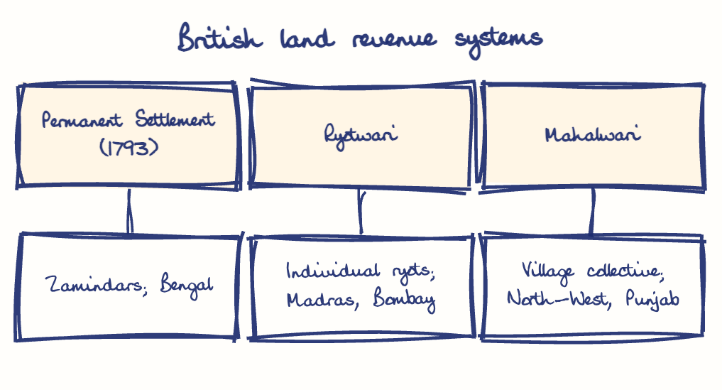
The British introduced the Permanent Settlement (Bengal, 1793), the Ryotwari system in Madras and Bombay, the Mahalwari system in north-western India and Ijaradari revenue farming, all to maximise revenue. They caused heavy taxation, peasant indebtedness, land alienation, agricultural stagnation and famines like the Madras famine of 1877.
Model answer
Ghissu Editorial · Verified 4 Oct 2026 · 299 words
Permanent Settlement (1793)
Introduced in Bengal, it fixed revenue permanently and made zamindars hereditary landowners, who prioritised rent extraction over agricultural investment.
Ryotwari and Mahalwari Systems
Ryotwari collected revenue directly from cultivators with frequent tax hikes causing insecurity; Mahalwari involved collective village settlements but imposed heavy, fluctuating taxes. Both systems failed to provide tenure security, discouraging farmers from improving land productivity.
Peasant Exploitation and Agricultural Decline
High taxes caused indebtedness and land loss2; famines like Madras 1877 highlighted agricultural stagnation. The lack of incentives for investment and insecure tenure led to low productivity and frequent rural crises.
Disintegration of Traditional Structures
Private property rights disrupted village communities, increasing rural inequality and caste-based disparities. The zamindari system entrenched landlord dominance, while ryotwari and mahalwari systems did not protect small cultivators, perpetuating social hierarchies.
Digitization and Transparency
Karnataka’s Bhoomi Project exemplifies digital land records improving transparency and farmer rights. Such initiatives reduce corruption and clarify land ownership, empowering cultivators.
Legal and Policy Reforms
Strengthening tenancy laws and land ceilings is vital to curb exploitation and promote equity. Post-independence land reforms must address the colonial legacy to ensure fair land distribution and secure tenure.
This model answer is indicative and the model can make mistakes; please verify key facts independently.
Sources
Practise this question
1Get the answer sheet
Sized for this question.
2Write your answer
Timed, by hand.
3Get it marked
Your score and what to fix.
This chapter in the exam
British Rule 1757-1856, the 1857 Revolt, Socio-Religious Reform & the Rise of Nationalism20 questions
Asked in 8 of 8 sittings since 2008
Most tested: Colonialism’s impact on Indian society/economy and reform-led social uplift, especially untouchability and caste reform.
- 2025What do you understand by the Permanent Settlement, and what impact did it have on Indian society? Comment.
- 2025What do you understand by the 'safety valve' theory? Explain it in the context of the Indian National Congress?
All 20 questions, sorted by sub-topic, with model answers and practice.
Question from the official APPSC Group-I Mains 2023 paper. Answer written by Ghissu's engine and checked against our editorial standards. Found an error? Tell us and we correct it within 48 hours.