Has communalism indirectly helped the British to perpetuate their control over India ? Examine the indicative traits of the Communalists and assess their impact on India's modern history.
In short
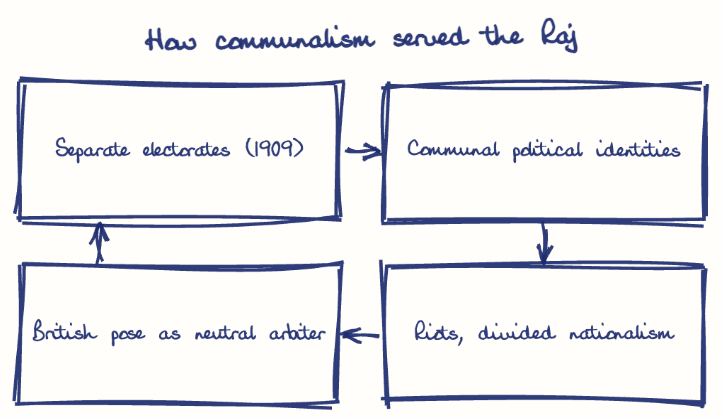
Yes, communalism indirectly sustained British rule by dividing Indians and letting the British justify their presence as protectors of order and minorities. Its traits were religious exclusivism, opportunism and collaboration, seen in separate electorates from 1909 and the Communal Award (1932), and its ultimate impact was partition in 1947.
Model answer
Ghissu Editorial · Verified 4 Oct 2026 · 301 words
Political Opportunism and Colonial Collaboration
Sir Syed Ahmed Khan urged Muslims to stay loyal and away from the Congress, and the Simla Deputation (1906) won separate electorates under the Indian Councils Act 1909, institutionalizing communal identities and deepening divides. This collaboration secured privileges for some but fragmented the nationalist movement.
Divide and Rule Strategy
The British institutionalized communal representation through the Morley-Minto Reforms (1909), the Communal Award (1932) and the Government of India Act (1935), deliberately fragmenting nationalist unity to prevent a united anti-colonial front.
Legitimizing Colonial Rule
By portraying India as irreconcilably divided along religious lines, the British justified their continued authority as necessary to maintain order and protect minorities, thereby delaying independence1 and sustaining their political dominance.
Fragmentation and Partition
Communalism fractured the nationalist movement, leading to the rise of the Muslim League and its demand for Pakistan, culminating in the violent 1947 partition that caused massive displacement and communal strife.
Post-Independence Challenges
Communalism posed ongoing challenges to India’s secular democratic framework, necessitating constitutional safeguards such as Articles 25-28 and the political integration of princely states to promote unity and communal harmony.
This model answer is indicative and the model can make mistakes; please verify key facts independently.
Practise this question
1Get the answer sheet
Sized for this question.
2Write your answer
Timed, by hand.
3Get it marked
Your score and what to fix.
This chapter in the exam
Indian Nationalism in Three Phases; Independence, Partition and After22 questions
Asked in 8 of 8 sittings since 2008
Most tested: Gandhian mass movements and their impact, alongside peasant mobilisation and communalism/partition.
- 2025Discuss the role and contributions of the moderate leaders of Congress from 1885 to 1905.
- 2025Describe the major movements led by Mahatma Gandhi between 1920 and 1947.
All 22 questions, sorted by sub-topic, with model answers and practice.
Question from the official APPSC Group-I Mains 2023 paper. Answer written by Ghissu's engine and checked against our editorial standards. Found an error? Tell us and we correct it within 48 hours.