Examine the scope of 'reasonable restrictions' and the 'test of reasonableness' in connection with Article 19 of the Indian Constitution.
In short
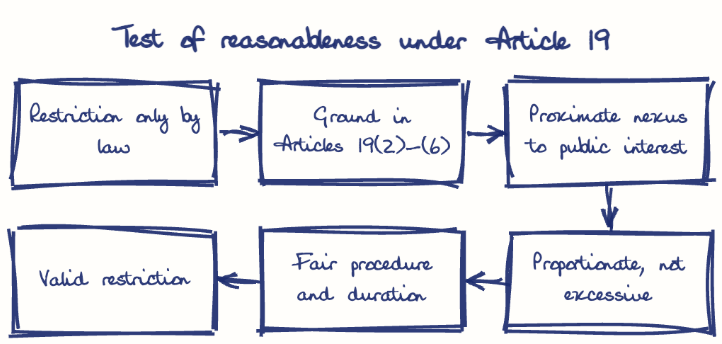
Article 19(2) to (6) allows only law to impose reasonable restrictions on the six freedoms for grounds like security, public order and morality, and courts test reasonableness through proportionality, proximate nexus and procedural fairness. In Shreya Singhal (2015), the Supreme Court struck down vague Section 66A.
Model answer
Ghissu Editorial · Verified 4 Oct 2026 · 261 words
Constitutional Grounds for Restrictions
Articles 19(2) to (6) authorize restrictions on freedoms such as speech and assembly for sovereignty, security, public order, morality, and foreign relations; for instance, restrictions on speech prevent defamation or incitement.
Legislative Authority and Limits
Restrictions must be imposed by law and be reasonable, not arbitrary or excessive, as held in Chintaman Rao v. State of Madhya Pradesh (1950), ensuring a balance between individual rights and social control.
Proportionality and Nexus Test
The Supreme Court in Shreya Singhal emphasized that restrictions must have a proximate nexus to the public interest, rejecting vague or broad laws like Section 66A of the IT Act.
Substantive and Procedural Reasonableness
Courts review both substance and procedure, as in Dr. N.B. Khare v. State of Delhi (1950), ensuring fairness in the duration and implementation of restrictions.
Judicial Review as Safeguard
The judiciary acts as a guardian of fundamental rights1 by scrutinizing restrictions to prevent arbitrary state action.
Integration with Article 21
The right to privacy under Article 21, recognized in the Puttaswamy judgment, also permits reasonable restrictions, complementing Article 19 protections.
This model answer is indicative and the model can make mistakes; please verify key facts independently.
Practise this question
1Get the answer sheet
Sized for this question.
2Write your answer
Timed, by hand.
3Get it marked
Your score and what to fix.
This chapter in the exam
Indian Constitution, Fundamental Rights, DPSP and Union-State functions18 questions
Asked in 8 of 8 sittings since 2008
Most tested: Rights, social justice, and constitutional safeguards for disadvantaged groups.
- 2025The Indian Constitution favours a federal type of government. Considering this, what duties does the Constitution place on State Governments to ensure the smooth functioning of the nation?
- 2025The Constitution of India grants certain rights to citizens and also provides measures to safeguard them. What are the key constitutional arrangements to ensure the protection of these rights?
All 18 questions, sorted by sub-topic, with model answers and practice.
Question from the official APPSC Group-I Mains 2023 paper. Answer written by Ghissu's engine and checked against our editorial standards. Found an error? Tell us and we correct it within 48 hours.