Explain the quasi-judicial nature of Administrative Tribunals. Examine whether writs and appeals are available against the decisions of the Administrative Tribunals.
In short
Administrative tribunals, created under Article 323-A and the Administrative Tribunals Act, 1985, are quasi-judicial: they decide service disputes by natural justice without strict procedural codes. After the Chandra Kumar judgment (1997), High Courts hear writs under Articles 226 and 227 against their decisions, and appeals lie where statutes provide.
Model answer
Ghissu Editorial · Verified 4 Oct 2026 · 278 words
Statutory Foundation and Specialized Jurisdiction
Created under the Administrative Tribunals Act, 1985 and Article 323-A, tribunals like the Central Administrative Tribunal, serving Andhra Pradesh through its Hyderabad bench, adjudicate public service disputes with technical expertise.
Judicial and Administrative Hybrid
Tribunals combine judicial powers with administrative functions, following natural justice but with procedural flexibility, enabling efficient dispute resolution while raising concerns about independence.
Judicial Review Affirmed
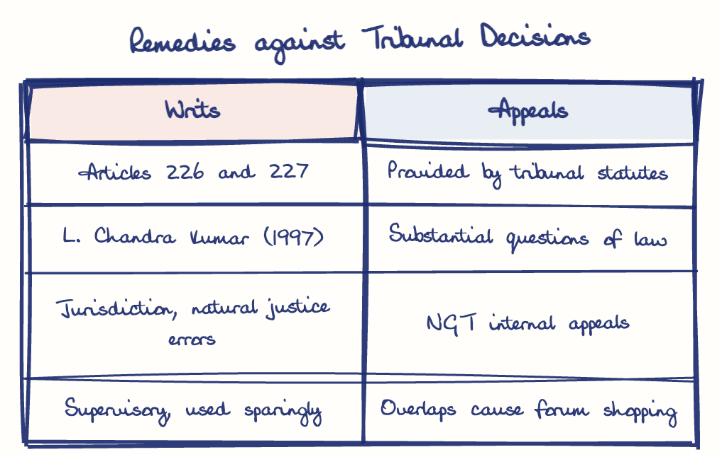
The Supreme Court in L. Chandra Kumar v. Union of India (1997) held tribunal decisions subject to writ jurisdiction under Articles 226 and 227, allowing High Courts to correct jurisdictional errors and violations of natural justice.
Practical Challenges in Andhra Pradesh
Andhra Pradesh High Court receives writ petitions challenging tribunal orders, but delays sometimes undermine speedy justice goals.
Statutory Appeal Provisions
The Administrative Tribunals Act provides no appeal, so CAT orders go first to a High Court division bench; other statutes provide appeals, such as from the National Green Tribunal to the Supreme Court.
Issues of Delay and Overlap
Overlapping jurisdictions and multiple tribunals in Andhra Pradesh cause procedural complexities and forum shopping.
Reform Efforts
The Tribunal Reforms Act1, 2021 aims to streamline appointments and tenure, though its provisions have faced Supreme Court scrutiny over tribunal independence.
This model answer is indicative and the model can make mistakes; please verify key facts independently.
Practise this question
1Get the answer sheet
Sized for this question.
2Write your answer
Timed, by hand.
3Get it marked
Your score and what to fix.
This chapter in the exam
Statutory, regulatory, quasi-judicial bodies and Civil Services9 questions
Asked in 6 of 8 sittings since 2008
Most tested: National Commission for Women and quasi-judicial bodies/Administrative Tribunals.
- 2025Under which Act was the National Commission for Women (NCW) established? Describe its main features and limitations.
- 2025Which constitutional provisions empower the formation of quasi-judicial authorities in India? Explain with suitable examples.
All 9 questions, sorted by sub-topic, with model answers and practice.
Question from the official APPSC Group-I Mains 2023 paper. Answer written by Ghissu's engine and checked against our editorial standards. Found an error? Tell us and we correct it within 48 hours.