Explain the scope of civil service reforms in India with a brief note on Mission Karmayogi.
In short
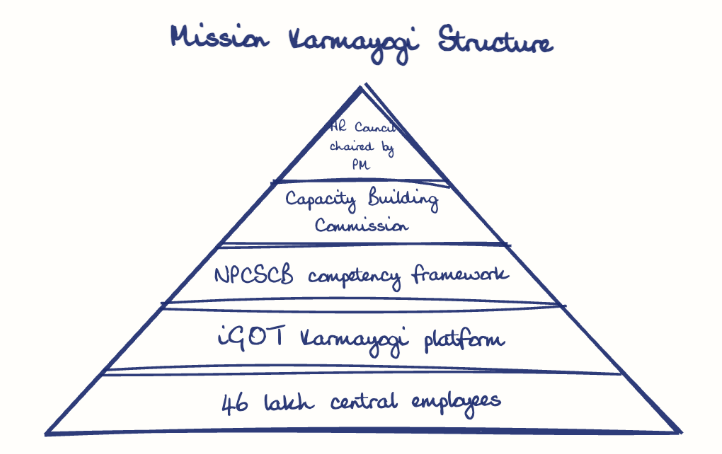
Civil service reform spans capacity building, role-based HR management, performance appraisal, specialist and lateral entry, and citizen-centric behavioural change to make the bureaucracy competent and accountable. Mission Karmayogi (NPCSCB) drives this through the iGOT Karmayogi platform, which has over 1.5 crore registered learners and more than 8 crore course completions.
Model answer
Ghissu Editorial · Verified 4 Oct 2026 · 244 words
NPCSCB Framework
Mission Karmayogi’s National Programme for Civil Services Capacity Building integrates behavioural, functional, and domain competencies, moving beyond traditional training to role-based HR management that links skills with job roles.
Audit Findings in Andhra Pradesh
Andhra Pradesh CAG 2025 audit reveals6 significant gaps in welfare, education and nutrition schemes, and public health audits show HR and funding shortfalls, underscoring the need for sustained capacity building and accountability reforms.
Scaling and Adoption
Over 1.5 crore learners registered on iGOT by 2026 with 8 crore course completions, demonstrating wide acceptance. However, challenges remain in resource-poor areas and bureaucratic resistance, requiring focused efforts to ensure uniform access and behavioural change.
Promoting Specialist Cadres
Encouraging lateral entry and specialist recruitment alongside Mission Karmayogi training will balance generalist and specialist roles, improving domain expertise and governance outcomes.
This model answer is indicative and the model can make mistakes; please verify key facts independently.
Practise this question
1Get the answer sheet
Sized for this question.
2Write your answer
Timed, by hand.
3Get it marked
Your score and what to fix.
This chapter in the exam
Statutory, regulatory, quasi-judicial bodies and Civil Services9 questions
Asked in 6 of 8 sittings since 2008
Most tested: National Commission for Women and quasi-judicial bodies/Administrative Tribunals.
- 2025Under which Act was the National Commission for Women (NCW) established? Describe its main features and limitations.
- 2025Which constitutional provisions empower the formation of quasi-judicial authorities in India? Explain with suitable examples.
All 9 questions, sorted by sub-topic, with model answers and practice.
Question from the official APPSC Group-I Mains 2023 paper. Answer written by Ghissu's engine and checked against our editorial standards. Found an error? Tell us and we correct it within 48 hours.