It is observed that much of present-day Indian bureaucracy is a result of British administration. In this connection, explain the evolution of Civil Service in India.
In short
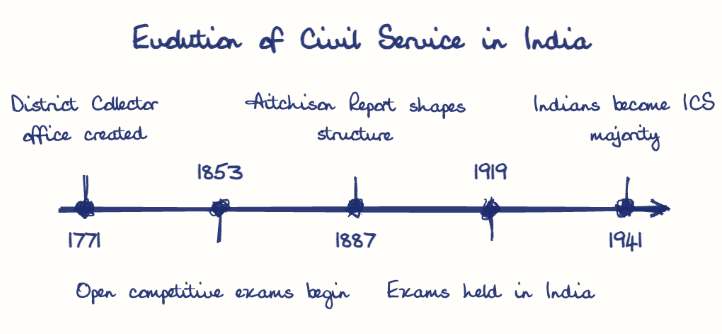
India's civil service grew from Company rule (District Collector, 1771) through the Charter Act 1853's open competitive exams and Indianisation after 1919 into the post-independence IAS. It keeps the British design of a generalist, merit-recruited, hierarchical service, though it now answers to citizens through instruments like the RTI Act 2005.
Model answer
Ghissu Editorial · Verified 4 Oct 2026 · 314 words
Colonial Institutionalization
The 1771 District Collector office and Lord Cornwallis’s reforms established the ICS; the 1853 Charter Act introduced open competitive exams, though initially London-based, restricting Indian participation. These reforms professionalized administration and separated civil from military roles.
Indianisation Efforts
The Aitchison Report (1887) structured the ICS; the Government of India Act (1919) allowed recruitment exams in India, increasing Indian representation; by 1941, Indians outnumbered Europeans in ICS. The Montagu-Chelmsford Reforms also expanded Indian involvement in governance, setting the stage for greater administrative inclusion.
Structural Legacy
The IAS retains Weberian bureaucracy1 features, permanence, hierarchy, merit-based recruitment, and continues British-era functions like law and order and revenue collection. The cadre system and generalist approach remain central to its functioning.
Development Focus
Modern bureaucracy emphasizes socio-economic development and digital public infrastructure2, as seen in India’s Digital Public Infrastructure and Andhra Pradesh’s DBT schemes. This shift reflects a move from control to service delivery and welfare orientation.
Challenges
Recurring exam paper leaks expose3 recruitment integrity gaps; bureaucratic rigidity and politicization hinder responsiveness. The legacy of closed corporate culture limits innovation and adaptability in governance.
This model answer is indicative and the model can make mistakes; please verify key facts independently.
Sources
Practise this question
1Get the answer sheet
Sized for this question.
2Write your answer
Timed, by hand.
3Get it marked
Your score and what to fix.
This chapter in the exam
Public Administration: meaning and evolution in India6 questions
Asked in 3 of 8 sittings since 2008
Most tested: Evolution of Indian administration from ancient statecraft to British colonial civil service and its continuing influence.
- 2025The administrative system of the Gupta dynasty was, in many ways, similar to that of the Mauryan Empire. Discuss the key similarities and differences between the two administrative structures.
- 2025What features of British administration have influenced the Indian administrative system?
All 6 questions, sorted by sub-topic, with model answers and practice.
Question from the official APPSC Group-I Mains 2023 paper. Answer written by Ghissu's engine and checked against our editorial standards. Found an error? Tell us and we correct it within 48 hours.