"NGOs play a critical role in promoting human rights, defending the marginalized, and creating a more just and equitable society." Comment on the role of NGO's in India.
In short
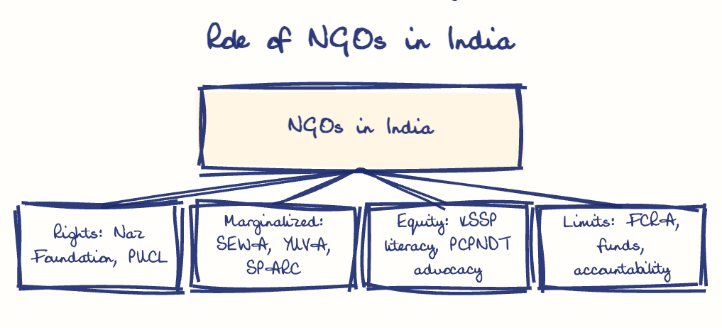
The statement holds: India's 3.2 million-plus NGOs promote human rights through advocacy and monitoring, defend the marginalised through legal aid and mobilisation, and advance equity in education and health. The Naz Foundation's campaign against Section 377 shows their impact, though FCRA curbs and accountability concerns limit their reach.
Model answer
Ghissu Editorial · Verified 4 Oct 2026 · 261 words
Legal Reform Advocacy
The Naz Foundation’s role in decriminalizing homosexuality under Section 377 expanded fundamental rights.
Awareness and Empowerment
PUCL raises civil liberties awareness, enabling marginalized groups to claim justice.
Monitoring and Reporting
Aid India’s COVID-19 outreach in Andhra Pradesh exemplifies NGOs’ role in documenting abuses and enhancing accountability.
Regulatory Challenges
Recent FCRA amendments restrict foreign funding, impacting NGO effectiveness.
Legal and Social Advocacy
NGOs in Andhra Pradesh partner with Gram Panchayats to implement the Forest Rights Act, protecting tribal land rights.
Service Delivery
SEWA ensures last-mile delivery of welfare schemes to women and informal workers, enhancing social inclusion.
Community Mobilization
Groups like YUVA and SPARC resist forced slum demolitions, strengthening grassroots democratic engagement.
Social Justice Promotion
Kerala Sastra Sahitya Parishad’s literacy campaigns advance social equity.
Policy Influence
NGOs have strengthened the PCPNDT Act to combat female feticide, reflecting transformative constitutionalism.
Environmental Justice
The Centre for Science and Environment champions sustainable development and equitable resource distribution.
FCRA Reform
Simplify foreign funding norms to sustain human rights work.
State-NGO Partnerships
Institutionalize collaboration, especially in Andhra Pradesh.
Capacity Building
Invest in training and technology for NGOs.
Community Governance
Promote grassroots participation.
This model answer is indicative and the model can make mistakes; please verify key facts independently.
Practise this question
1Get the answer sheet
Sized for this question.
2Write your answer
Timed, by hand.
3Get it marked
Your score and what to fix.
This chapter in the exam
Development processes: civil society and NGOs7 questions
Asked in 3 of 8 sittings since 2008
Most tested: Role of NGOs/civil society in democracy and social justice
- 2025What do you understand by civil society in the Indian context? Discuss its key features and the limitations it faces in a democratic system.
- 2025In what ways can the role of NGOs be enhanced in promoting women's empowerment and welfare in India? Discuss, with a focus on the key challenges they encounter.
All 7 questions, sorted by sub-topic, with model answers and practice.
Question from the official APPSC Group-I Mains 2023 paper. Answer written by Ghissu's engine and checked against our editorial standards. Found an error? Tell us and we correct it within 48 hours.