"The concept of the welfare state had been crystallised in Kautilya's ideas long before it came to be envisioned in Western Europe' — Examine this statement.
In short
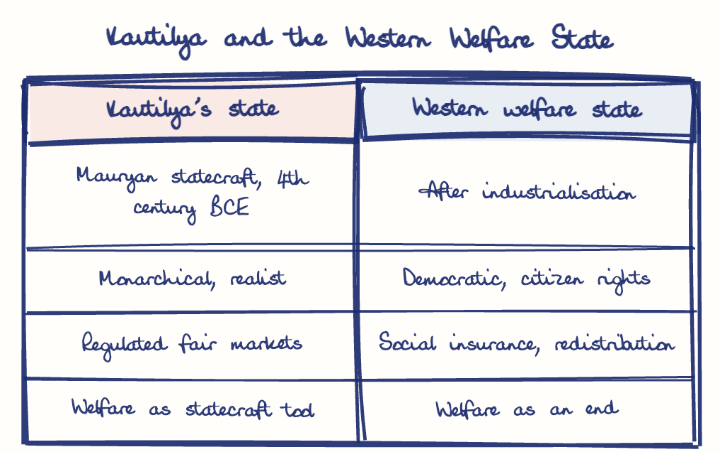
The statement is largely justified: Kautilya's Arthashastra made the king's happiness depend on his subjects' welfare and bound him to duties of protection (rakshana) and welfare (palana) centuries before Europe. Its democratic, rights-based form, with formal social security and redistribution, is however a later Western contribution.
Model answer
Ghissu Editorial · Verified 4 Oct 2026 · 268 words
People-Centric Governance
Kautilya’s famous dictum, "In the happiness of his subjects lies his happiness; in their welfare, his welfare," underscores the king’s legitimacy based on public prosperity. This reflects a foundational welfare state principle where the ruler’s success depends on the people’s contentment.
Comprehensive Welfare Duties
The Arthashastra details the king’s duty for protection (rakshana) and welfare (palana), including economic security, social order, and justice. It mandates state intervention in public goods and social justice, showing a holistic governance model beyond mere military or fiscal concerns.
Economic Regulation vs. Redistribution
Kautilya advocated regulated markets with state control of key resources like forests and mines, balancing private ownership with social welfare. This contrasts with Western states’ redistributive social insurance systems developed in response to industrial capitalism’s inequalities.
Integration of Welfare and Security
His concept of yoga kshema1 links welfare with political stability, reflecting modern welfare states’ balance of social welfare and national security. This anticipates the state’s role in ensuring both prosperity and order.
This model answer is indicative and the model can make mistakes; please verify key facts independently.
Sources
Practise this question
1Get the answer sheet
Sized for this question.
2Write your answer
Timed, by hand.
3Get it marked
Your score and what to fix.
This chapter in the exam
Public Administration: meaning and evolution in India6 questions
Asked in 3 of 8 sittings since 2008
Most tested: Evolution of Indian administration from ancient statecraft to British colonial civil service and its continuing influence.
- 2025The administrative system of the Gupta dynasty was, in many ways, similar to that of the Mauryan Empire. Discuss the key similarities and differences between the two administrative structures.
- 2025What features of British administration have influenced the Indian administrative system?
All 6 questions, sorted by sub-topic, with model answers and practice.
Question from the official APPSC Group-I Mains 2023 paper. Answer written by Ghissu's engine and checked against our editorial standards. Found an error? Tell us and we correct it within 48 hours.