The office of the Governor in certain situations carries with it the exercise of 'discretionary functions' and 'special responsibilities'. Discuss this statement in view of the constitutional provisions.
In short
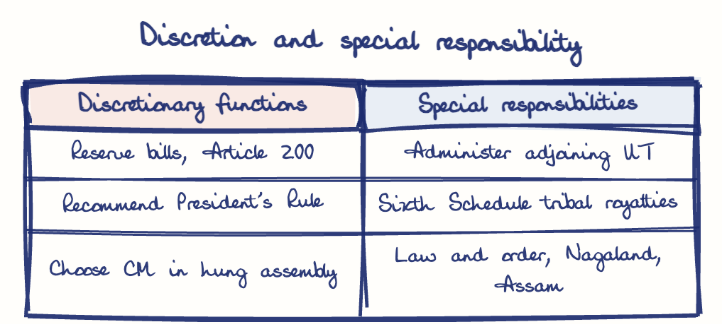
Though the Governor usually acts on ministerial advice, Article 163(2) allows discretion in reserving bills under Article 200, recommending President's Rule under Article 356 and choosing a Chief Minister in hung assemblies. Special responsibilities include Sixth Schedule tribal matters and law and order under Articles 371A and 371H.
Model answer
Ghissu Editorial · Verified 4 Oct 2026 · 253 words
Constitutional Provision
Article 163(2) empowers the Governor to act in discretion, with final decisions immune from judicial review, ensuring independent action when necessary.
Hung Assembly and Political Crises
The Governor’s discretion in appointing Chief Ministers or dissolving assemblies is critical in hung assemblies, as seen in Karnataka in 2018, impacting Centre-State relations1.
President’s Rule Recommendation
Article 356 allows the Governor to recommend President’s Rule if constitutional machinery fails; the S.R. Bommai case curbed misuse of this power.
Reservation of Bills
Under Article 200, the Governor can reserve bills for the President’s consideration, acting as a constitutional check on state legislation.
Tribal Areas and Autonomous Councils
The Governor administers tribal district councils under the Sixth Schedule, safeguarding tribal rights in states like Assam and Meghalaya.
Union Territories Administration
When assigned, the Governor independently manages adjoining Union Territories, balancing state and Union interests.
Fixed Tenure
The Sarkaria and Punchhi Commissions urged a secure five-year tenure and transparent removal to enhance Governor’s independence.
Clear Guidelines
Issuing strict Centre guidelines on discretionary powers will prevent misuse, especially in assembly dissolution and President’s Rule imposition.
This model answer is indicative and the model can make mistakes; please verify key facts independently.
Practise this question
1Get the answer sheet
Sized for this question.
2Write your answer
Timed, by hand.
3Get it marked
Your score and what to fix.
This chapter in the exam
Federal structure, Governor and distribution of powers17 questions
Asked in 8 of 8 sittings since 2008
Most tested: Centre–State balance and the extent of Union supremacy over States
- 2025The procedure of enacting a law from a bill differs at the Union and State levels, primarily to safeguard the interests of the Union Government in state legislation. Elucidate this aspect.
- 2025Although States have their separate list for law-making, this authority is not beyond the overarching legislative powers of the Parliament. Examine.
All 17 questions, sorted by sub-topic, with model answers and practice.
Question from the official APPSC Group-I Mains 2023 paper. Answer written by Ghissu's engine and checked against our editorial standards. Found an error? Tell us and we correct it within 48 hours.