What are the reasons for decline of integrity in civil services ? Also, discuss the institutional mechanism to check corruption in India.
In short
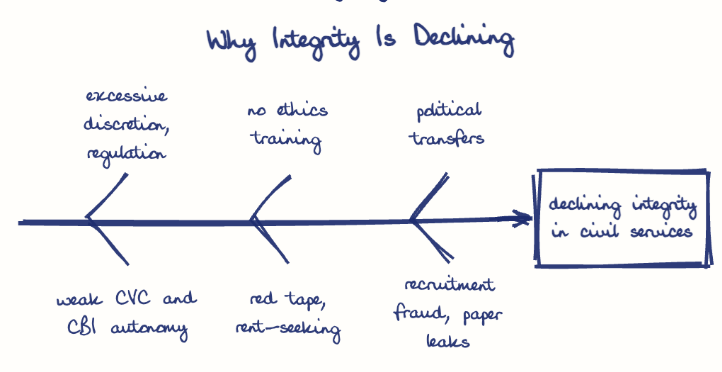
Integrity has declined because of excessive discretion and regulation, weak oversight bodies, poor ethical training, red tape and politically driven transfers. Checks include the Central Vigilance Commission (1964), the CBI, state vigilance commissions, the Prevention of Corruption Act, the Lokpal and Lokayuktas, and e-governance such as Andhra Pradesh's CFMS.
Model answer
Ghissu Editorial · Verified 4 Oct 2026 · 321 words
Excessive Discretion and Regulation
The Santhanam Committee (1962) identified excessive regulatory burden and discretionary powers fostering corruption. Complex procedures and lack of transparency create opportunities for misuse.
Weak Accountability
The Central Vigilance Commission (CVC) and CBI face political interference, reducing their effectiveness in curbing corruption. Limited autonomy hampers timely investigation and prosecution.
Vigilance Bodies
The CVC and Andhra Pradesh vigilance commissions monitor and prosecute corruption but need greater autonomy. Political insulation is essential for their effectiveness.
E-Governance and Training
Andhra Pradesh’s CFMS aims to enhance transparency by reducing human interface, while Mission Karmayogi promotes ethical competence and continuous capacity building among civil servants.
Strengthen Autonomy and Ethics
Grant independence to vigilance bodies and institutionalize ethics training to rebuild integrity. Embedding values through programs like the National Centre for Good Governance can foster a culture of probity.
Reduce Political Interference and Procedural Delays
Minimizing frequent transfers and streamlining administrative processes will improve morale and reduce corruption incentives.
This model answer is indicative and the model can make mistakes; please verify key facts independently.
Practise this question
1Get the answer sheet
Sized for this question.
2Write your answer
Timed, by hand.
3Get it marked
Your score and what to fix.
This chapter in the exam
Statutory, regulatory, quasi-judicial bodies and Civil Services9 questions
Asked in 6 of 8 sittings since 2008
Most tested: National Commission for Women and quasi-judicial bodies/Administrative Tribunals.
- 2025Under which Act was the National Commission for Women (NCW) established? Describe its main features and limitations.
- 2025Which constitutional provisions empower the formation of quasi-judicial authorities in India? Explain with suitable examples.
All 9 questions, sorted by sub-topic, with model answers and practice.
Question from the official APPSC Group-I Mains 2023 paper. Answer written by Ghissu's engine and checked against our editorial standards. Found an error? Tell us and we correct it within 48 hours.