Explain the impact of Digital Public Infrastructure on the socio-economic development in India. Discuss the steps taken by the Indian Government to accelerate digital infrastructure and to reduce digital divide in India.
In short
Digital Public Infrastructure such as Aadhaar, UPI and DigiLocker has widened financial inclusion, improved service delivery and governance and boosted the digital economy, though rural and social divides persist. The government has extended BharatNet to over 2.15 lakh Gram Panchayats, rolled out 5G nationwide and promoted PMGDISHA digital literacy.
Model answer
Ghissu Editorial · Verified 4 Oct 2026 · 274 words
India’s Digital Public Infrastructure1 (DPI) drives socio-economic development by improving connectivity, inclusion, and governance, with the digital economy contributing 11.74%32 to GDP in 2022-23.
Impact of Digital Public Infrastructure on Socio-Economic Development
Impact of Digital Public Infrastructure on Socio-Economic Development → Digital Infrastructure Expansion → Increased Access to Services and Financial Inclusion → Economic Growth and Employment Generation → Challenges of Digital Divide and Inclusion
1. Financial Inclusion and Service Delivery: Aadhaar, UPI, and DigiLocker have formalised access for over a billion people; UPI recorded 1,867.7 crore transactions worth ₹24.77 lakh crore in April 2025. 2. Economic Growth and Employment: Digital sectors grow faster than traditional ones, supporting youth employment and skills development. 3. Governance and Transparency: UMANG offers 2,300+ services in 23 languages, enhancing rural service delivery. 4. Digital Divide Challenges: Andhra Pradesh4 shows rural connectivity and literacy gaps limiting DPI’s full impact.
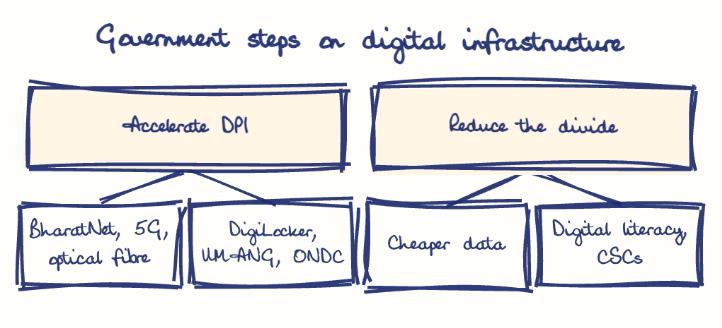
Digital India and BharatNet
Connected 2.15 lakh Gram Panchayats with high-speed internet, improving rural access.
5G and Optical Fibre Expansion
5G covers 99.9% of districts; optical fibre route km rose from 19.35 lakh in 2019 to 42.36 lakh in 2025.
Affordable Internet and Devices
Data costs dropped from ₹269/GB in 2014 to ₹8-10/GB in 2025-26; tele-density reached 84.49% in October 2024.
Digital Literacy and Inclusive Services
PMGDISHA and UMANG improve digital skills and accessibility, especially in Andhra Pradesh.
This model answer is indicative and the model can make mistakes; please verify key facts independently.
Practise this question
1Get the answer sheet
Sized for this question.
2Write your answer
Timed, by hand.
3Get it marked
Your score and what to fix.
This chapter in the exam
Infrastructure in India10 questions
Asked in 4 of 8 sittings since 2008
Most tested: Public-private partnership: scope, problems, and restructuring.
- 2025Discuss the current state of transport infrastructure in India and its contribution to economic development. Highlight key challenges and suggest policy measures for improving its efficiency and reach.
- 2025Discuss the significance of solar energy in India's renewable energy strategy. Highlight the major initiatives, achievements and challenges in the promotion of solar power.
All 10 questions, sorted by sub-topic, with model answers and practice.
Question from the official APPSC Group-I Mains 2023 paper. Answer written by Ghissu's engine and checked against our editorial standards. Found an error? Tell us and we correct it within 48 hours.