What are the different fiscal policy tools used in India ? Can Customs and Excise Duties be used as flexible fiscal policy tools in order to increase revenue and control inflation ? Discuss.
In short
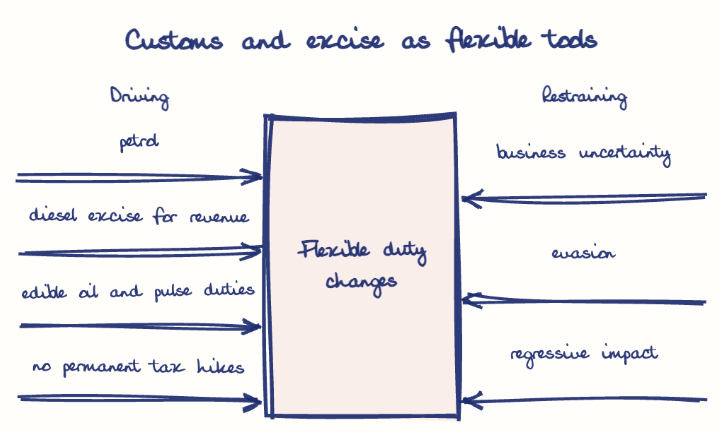
India's fiscal tools are direct taxes, indirect taxes such as GST, customs and excise duties, public expenditure and borrowing. Customs and excise can be flexible tools, as pandemic excise hikes on fuel raised revenue and FY23 edible oil duty cuts eased prices, though frequent changes create uncertainty.
Model answer
Ghissu Editorial · Verified 4 Oct 2026 · 257 words
Direct and Indirect Taxes
Direct taxes, including Income and Corporate Tax, contribute over half of tax revenue, showing resilience post-pandemic1; indirect taxes like GST, Customs, and Excise Duties remain crucial, especially for petroleum and alcohol sectors.
Revenue and Inflation Management
Excise duties were raised on petrol and diesel during the pandemic to boost revenue and later reduced to ease inflation; lowering customs duties on edible oils in FY23 helped control food inflation, benefiting low-income households in Andhra Pradesh.
Challenges and Trade-offs
Frequent duty changes cause business uncertainty and evasion risks, as seen in Andhra Pradesh’s commercial tax audits revealing ₹2,772 crore outstanding revenue observations (2023).
Improve Enforcement and Simplify Duties
Strengthening compliance and rationalizing duty structures will reduce leakages and litigation.
Strategic Duty Modulation
Continue flexible adjustments aligned with macroeconomic conditions, integrating duties with broader fiscal reforms including expanding the tax base and enhancing capital expenditure.
This model answer is indicative and the model can make mistakes; please verify key facts independently.
Practise this question
1Get the answer sheet
Sized for this question.
2Write your answer
Timed, by hand.
3Get it marked
Your score and what to fix.
This chapter in the exam
Resource Mobilization in Indian Economy19 questions
Asked in 7 of 8 sittings since 2008
Most tested: Public debt and its sustainability in post-reform India.
- 2025Differentiate between internal and external public debt. Explain their relative advantages and risks for a developing country like India.
- 2025Discuss the key instruments of Monetary Policy (RBI) and Fiscal Policy in India and evaluate their role in resource mobilisation and inflation management.
All 19 questions, sorted by sub-topic, with model answers and practice.
Question from the official APPSC Group-I Mains 2023 paper. Answer written by Ghissu's engine and checked against our editorial standards. Found an error? Tell us and we correct it within 48 hours.