What are the factors that spur foreign investment in India ? Explain the major features of India's Consolidated Foreign Direct Investment (FDI) Policy. Briefly discuss the present situation of the FDI equity inflows in India.
In short
India's market size, growth, reforms and the China+1 shift attract investors, and its FDI policy allows 100% foreign equity in most sectors via the automatic route. Equity inflows reached about US$ 50 billion in the first nine months of FY 2024-25, up 13%, though repatriations dented net FDI.
Model answer
Ghissu Editorial · Verified 4 Oct 2026 · 282 words
Comprehensive Liberalisation
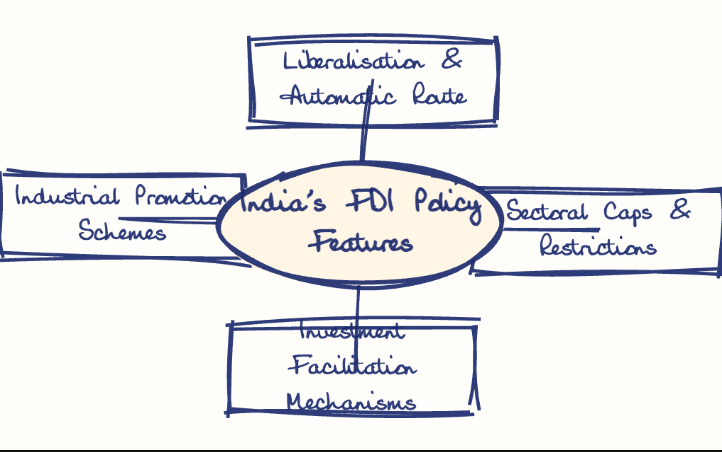
India’s consolidated FDI policy allows 100%21 foreign equity in most sectors under the automatic route, with sectoral caps in strategic areas and periodic revisions via press notes. Sectors like petroleum and pharmaceuticals are fully open, while banking and defence have prescribed limits.
Facilitation Mechanisms and Schemes
The Foreign Investment Implementation Authority, National Single Window System, and schemes like Make in India3, PLI, Start-up India, and PM GatiShakti create a conducive environment for investors. These initiatives streamline approvals, improve infrastructure, and incentivize manufacturing and innovation.
Strong Equity Inflows Amid Global Volatility
FDI equity inflows rose 13% to about US$ 50 billion in nine months of FY 2024-25, while repatriations nearing US$ 40 billion reflect profitable exits and market maturity. This indicates growing investor confidence despite global economic uncertainties.
Technological and Strategic Integration
Projects like Amazon Web Services’ $8.2 billion AI investment in Maharashtra and Foxconn’s $1.5 billion iPhone expansion illustrate India’s role in global value chains. These investments bring advanced technology and support the “China+1” diversification strategy.
This model answer is indicative and the model can make mistakes; please verify key facts independently.
Practise this question
1Get the answer sheet
Sized for this question.
2Write your answer
Timed, by hand.
3Get it marked
Your score and what to fix.
This chapter in the exam
Resource Mobilization in Indian Economy19 questions
Asked in 7 of 8 sittings since 2008
Most tested: Public debt and its sustainability in post-reform India.
- 2025Differentiate between internal and external public debt. Explain their relative advantages and risks for a developing country like India.
- 2025Discuss the key instruments of Monetary Policy (RBI) and Fiscal Policy in India and evaluate their role in resource mobilisation and inflation management.
All 19 questions, sorted by sub-topic, with model answers and practice.
Question from the official APPSC Group-I Mains 2023 paper. Answer written by Ghissu's engine and checked against our editorial standards. Found an error? Tell us and we correct it within 48 hours.