What is meant by Monetary Policy Transmission? Explain the issues experienced during the process of Monetary Policy and suggest steps to overcome these issues.
In short
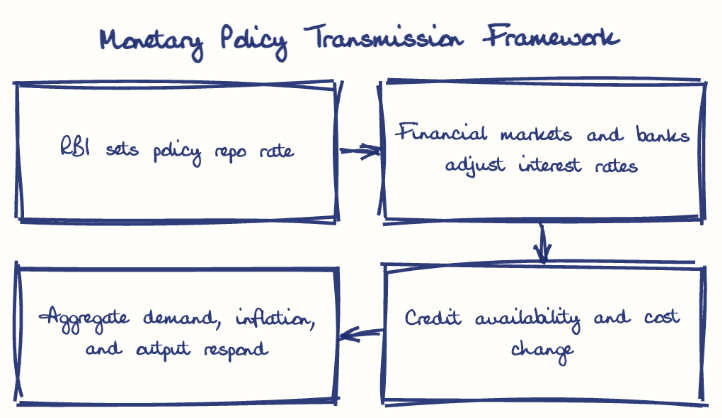
Monetary policy transmission is how changes in the RBI's repo rate pass through banks and markets to lending rates, credit, demand, output and inflation. Partial pass-through, NBFC and MFI rates that ignore policy, heavy government borrowing and long lags weaken it, which bank reforms and fiscal consolidation can ease.
Model answer
Ghissu Editorial · Verified 4 Oct 2026 · 297 words
RBI and Monetary Policy Committee2
Since 2016, the RBI’s Monetary Policy Committee sets repo rates targeting inflation under a rule-based framework, ensuring transparency.
Financial Market Constraints
Mandated government securities holdings and high fiscal deficits, including Andhra Pradesh’s, limit market-driven interest rates, reducing transmission efficiency.
Incomplete Pass-Through
A 200 basis points policy rate cut (2015-18) led to only 154 basis points decline in lending rates, with fresh loans transmitting better than outstanding ones.
Segmented Credit Markets
NBFCs, SHGs, and MFIs, accounting for one-third of lending, do not adjust rates with RBI policy, weakening transmission especially in rural Andhra Pradesh.
Fiscal Deficit and Borrowing
Persistent high deficits at Centre and states like Andhra Pradesh cause government borrowing that crowds out private credit, keeping interest rates high.
Banking Sector Reforms
Recapitalisation and stressed asset resolution in Andhra Pradesh’s banks will improve credit responsiveness.
Align NBFC and MFI Rates
Regulatory steps to link their lending rates with RBI policy will enhance transmission in underserved areas.
Fiscal Consolidation
Andhra Pradesh must reduce revenue deficits to lower borrowing and free credit for private investment.
Deepen Financial Markets
Improving government securities liquidity will aid better monetary policy pass-through.
This model answer is indicative and the model can make mistakes; please verify key facts independently.
Practise this question
1Get the answer sheet
Sized for this question.
2Write your answer
Timed, by hand.
3Get it marked
Your score and what to fix.
This chapter in the exam
Resource Mobilization in Indian Economy19 questions
Asked in 7 of 8 sittings since 2008
Most tested: Public debt and its sustainability in post-reform India.
- 2025Differentiate between internal and external public debt. Explain their relative advantages and risks for a developing country like India.
- 2025Discuss the key instruments of Monetary Policy (RBI) and Fiscal Policy in India and evaluate their role in resource mobilisation and inflation management.
All 19 questions, sorted by sub-topic, with model answers and practice.
Question from the official APPSC Group-I Mains 2023 paper. Answer written by Ghissu's engine and checked against our editorial standards. Found an error? Tell us and we correct it within 48 hours.