Climate change is a global concern which needs urgent intervention to combat it — Explain why. Discuss how climate smart agriculture mitigates the devastating effects of climate change.
In short
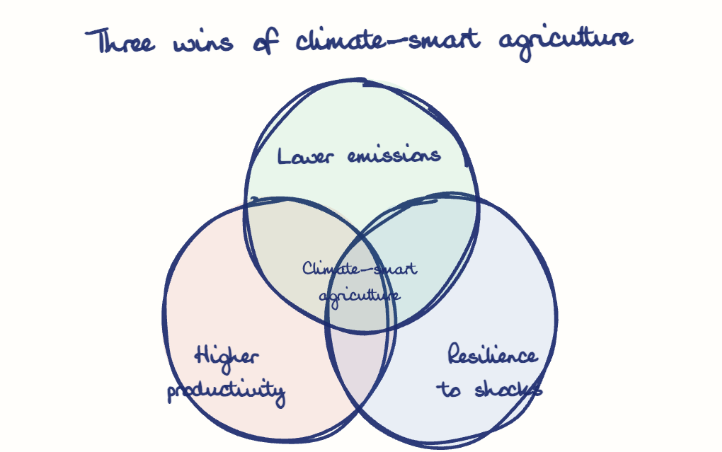
Climate change needs urgent action because it threatens food, water and livelihoods, with projected Indian yield losses of up to 35% in rice and 60% in maize by 2039. Climate-smart agriculture counters this with sustainable yields, drought-resistant crops, drip irrigation and carbon sequestration, as Andhra Pradesh's APCNF natural farming shows.
Model answer
Ghissu Editorial · Verified 4 Oct 2026 · 254 words
Agricultural Yield Declines
Projected losses of 35% in rice and 60% in maize by 2039 threaten food security in India, affecting millions dependent on farming for livelihood.
Water Stress and Conflict
Agriculture consumes 80-90% of water; drought-prone regions like Rayalaseema, Andhra Pradesh face intensified water scarcity and conflicts over resources, worsening socio-economic disparities.
Emission Reduction and Institutional Support
Agroforestry and afforestation under CAMPA funds sequester carbon and support biodiversity; the National Mission for Sustainable Agriculture (NMSA) in Andhra Pradesh integrates climate risk management with farmer welfare through credit access and extension services.
Scaling CSA and Water Management
Expand CSA through targeted subsidies and farmer training, strengthen water-efficient technologies in vulnerable districts like Rayalaseema, and enhance soil and crop monitoring using Andhra Pradesh’s soil health card data to tailor interventions effectively.
Community Empowerment and Policy Backing
Foster local institutions and farmer collectives to co-create adaptation strategies, ensuring inclusivity and sustainability alongside robust policy frameworks.
This model answer is indicative and the model can make mistakes; please verify key facts independently.
Practise this question
1Get the answer sheet
Sized for this question.
2Write your answer
Timed, by hand.
3Get it marked
Your score and what to fix.
This chapter in the exam
Development vs Environment: natural resources, climate change, EIA, natural disasters48 questions
Asked in 8 of 8 sittings since 2008
Most tested: Climate change and mining/environmental degradation links
- 2025Explain the different types of natural resources in India. How are they being conserved through government initiatives?
- 2025Investigate the relationship between mining activities and the occurrence of earthquakes. Explain how mining operations can be regulated to minimize seismic risks.
All 48 questions, sorted by sub-topic, with model answers and practice.
Question from the official APPSC Group-I Mains 2023 paper. Answer written by Ghissu's engine and checked against our editorial standards. Found an error? Tell us and we correct it within 48 hours.