The most important climate goal is limiting the Earth's warming to 1·5° Celsius. What happens to the world if we pass the crucial 1·5° Celsius climate threshold?
In short
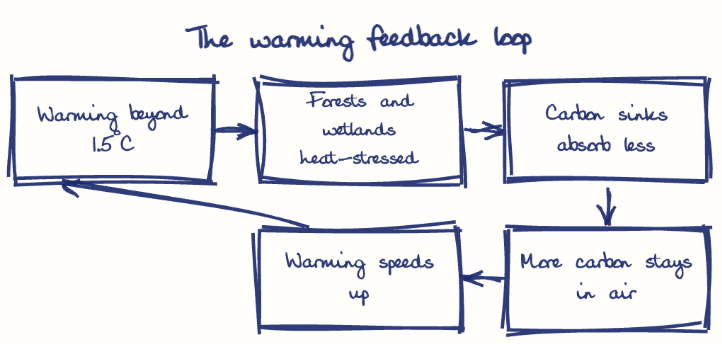
Passing 1.5°C would turn manageable climate risks into irreversible ones: fiercer heat and cyclones, coral and marine collapse, weaker carbon sinks, falling crop yields, health crises and displacement. 2024 already reached 1.55°C above pre-industrial levels, and the IPCC warns of tipping points such as Himalayan glacier loss.
Model answer
Ghissu Editorial · Verified 4 Oct 2026 · 255 words
Accelerated Biodiversity Loss
Exceeding 1.5°C intensifies habitat degradation and species extinction, disrupting ecosystem services vital for agriculture and resilience, notably along Andhra Pradesh’s 974 km coastline.
Extreme Weather and Marine Damage
Increased heatwaves, droughts in Rayalaseema, and coral bleaching threaten local ecosystems and fisheries in Visakhapatnam, undermining food security.
Food Security and Health Risks
Crop yield declines and pest outbreaks jeopardize livelihoods in Andhra Pradesh’s horticulture sectors; heat stress and diseases disproportionately affect marginalized communities.
Economic and Migration Challenges
Climate disasters strain infrastructure and trade in Visakhapatnam, while environmental degradation drives migration to cities like Vijayawada, raising governance issues.
Avoiding Irreversible Damage
IPCC reports warn of tipping points such as irreversible Himalayan glacier melt if 1.5°C is surpassed, while coastal Andhra Pradesh faces faster sea-level rise.
Carbon Budget and Equity
The shrinking global carbon budget demands urgent emission cuts; Andhra Pradesh’s renewable energy efforts align with India’s 450 GW goal and climate justice principles.
International and National Commitments
COP 30’s call to triple adaptation finance2, despite no agreed fossil fuel phase-out roadmap, combined with national schemes like the National Adaptation Fund, highlight the need for coordinated action.
This model answer is indicative and the model can make mistakes; please verify key facts independently.
Practise this question
1Get the answer sheet
Sized for this question.
2Write your answer
Timed, by hand.
3Get it marked
Your score and what to fix.
This chapter in the exam
Development vs Environment: natural resources, climate change, EIA, natural disasters48 questions
Asked in 8 of 8 sittings since 2008
Most tested: Climate change and mining/environmental degradation links
- 2025Explain the different types of natural resources in India. How are they being conserved through government initiatives?
- 2025Investigate the relationship between mining activities and the occurrence of earthquakes. Explain how mining operations can be regulated to minimize seismic risks.
All 48 questions, sorted by sub-topic, with model answers and practice.
Question from the official APPSC Group-I Mains 2023 paper. Answer written by Ghissu's engine and checked against our editorial standards. Found an error? Tell us and we correct it within 48 hours.