What are Gene Sanctuaries ? How do they protect the genetic diversity of plants in India ?
In short
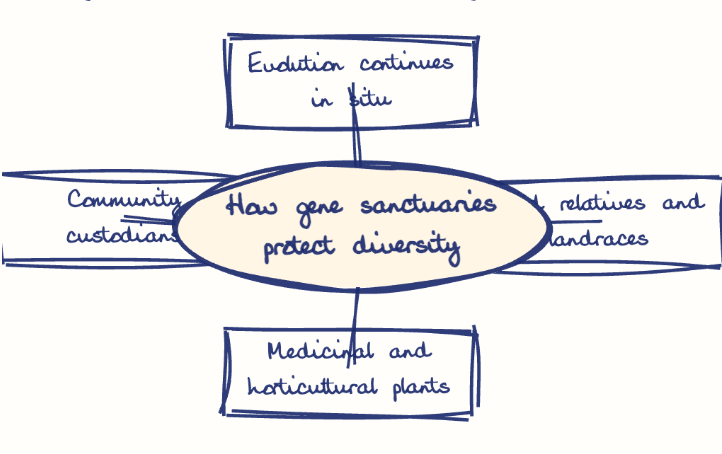
Gene sanctuaries are protected natural sites where wild relatives and landraces of crops are conserved in situ, letting them keep evolving under natural selection. They preserve adaptive traits breeders need for climate-resilient crops and complement NBPGR's gene banks, as the citrus sanctuary at Nokrek in Meghalaya shows.
Model answer
Ghissu Editorial · Verified 4 Oct 2026 · 267 words
Legal and Policy Support
India’s Biological Diversity Act, 2002, and institutions like NBPGR enable gene sanctuaries, exemplified by the citrus gene sanctuary in Meghalaya’s Garo Hills under the Man and Biosphere Reserve programme. The Ministry of Environment, Forest and Climate Change also plays a pivotal role in policy formulation and implementation.
Community Involvement
Women seed-guardians in Meghalaya preserve 57 heirloom seed varieties1, highlighting local stewardship in agrobiodiversity conservation. Institutional mechanisms increasingly recognize and incentivize such community roles, linking conservation with livelihoods and traditional knowledge.
Integration with Protected Areas
Gene sanctuaries often overlap with protected areas like Nokrek Biosphere Reserve in Meghalaya, conserving wild crop relatives and supporting ecosystem health. This integration helps protect genetic diversity within broader ecological contexts.
Management Challenges
Resource constraints and land-use pressures, such as in Andhra Pradesh’s Rayalaseema drought belt, limit sanctuary effectiveness. Challenges include habitat protection, controlling human interference, and managing biotic threats. Nonetheless, sanctuaries have successfully safeguarded medicinal and horticultural diversity vital for local economies.
Strengthen Coordination and Funding
Enhance collaboration among central, state, and community actors, especially in Andhra Pradesh, to improve sanctuary management with adequate technical support and monitoring.
This model answer is indicative and the model can make mistakes; please verify key facts independently.
Sources
Practise this question
1Get the answer sheet
Sized for this question.
2Write your answer
Timed, by hand.
3Get it marked
Your score and what to fix.
This chapter in the exam
Biotechnology & Nanotechnology: scope, ethics, genetic engineering, biodiversity, fermentation, immuno-diagnosis50 questions
Asked in 8 of 8 sittings since 2008
Most tested: Biodiversity and biotechnology governance/ethics, especially conservation, GMOs, and applied public-health biotech.
- 2025Trace the evolution of India's National Biotechnology Development Strategy (NBDS) and discuss its key objectives. Critically evaluate its impact on the growth of the biotechnology sector in India.
- 2025Analyze the potential of plant-derived biopharmaceuticals in promoting sustainable healthcare. Explain how the application of green pharmacy principles can help minimize environmental harm at each stage of the pharmaceutical lifecycle.
All 50 questions, sorted by sub-topic, with model answers and practice.
Question from the official APPSC Group-I Mains 2023 paper. Answer written by Ghissu's engine and checked against our editorial standards. Found an error? Tell us and we correct it within 48 hours.