What are the reasons behind the India's opposition to sign the Non-Proliferation of nuclear weapons (NPT) ? Discuss the impact of the civil nuclear agreement with the Nuclear Supplier Group (NSG) on nuclear power generation in India.
In short
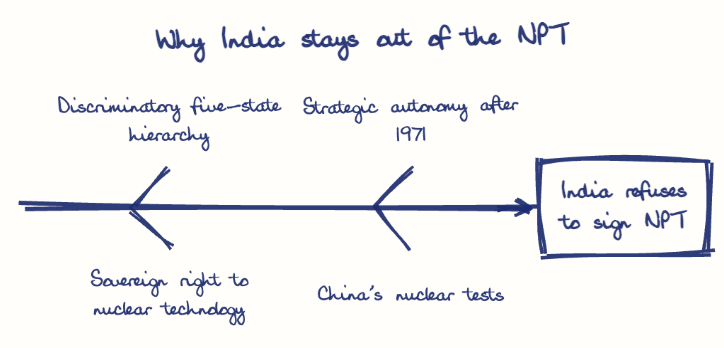
India refuses to sign the NPT as discriminatory, since it recognises only five nuclear-weapon states and curbs India's strategic autonomy. The 2008 NSG waiver opened imports of nuclear fuel and technology, supporting growth from about 8.7 GW towards 22.48 GW by 2031-32, though liability issues have stalled projects like Kovvada.
Model answer
Ghissu Editorial · Verified 4 Oct 2026 · 332 words
Strategic Autonomy Priority
India’s doctrine emphasizes independent deterrence, rejecting treaties limiting its nuclear weapons capability, shaped by historical conflicts like the 1971 war and China’s nuclear tests, reinforcing the need for strategic flexibility.
Non-Signatory Status and Diplomatic Isolation
India’s refusal to sign the NPT led to sanctions and limited technology access, but also strengthened its resolve to pursue an autonomous nuclear program, demonstrated by the 1974 peaceful nuclear explosion and 1998 nuclear tests.
NSG Waiver and Cooperation
The 2008 NSG waiver recognized India’s non-proliferation credentials, enabling nuclear imports and expanding capacity from 8.7 GW toward 22.48 GW by 2031-32, with a long-term target of 100 GW by 2047.
Strategic and Economic Benefits
The civil nuclear deal with the US and NSG engagement have strengthened India’s strategic partnerships and opened opportunities for India to become a competitive nuclear supplier globally.
Reform Liability Framework
Streamlining liability laws will attract foreign partners and accelerate civil nuclear projects by providing clarity and assurance.
Boost Indigenous Technology
Investing in Small Modular Reactors1 (SMRs) and advanced technologies will reduce import dependence and enhance energy security, supporting sustainable growth.
This model answer is indicative and the model can make mistakes; please verify key facts independently.
Sources
Practise this question
1Get the answer sheet
Sized for this question.
2Write your answer
Timed, by hand.
3Get it marked
Your score and what to fix.
This chapter in the exam
Energy: needs, resources, policy; Nuclear programme and policy24 questions
Asked in 8 of 8 sittings since 2008
Most tested: Renewable energy transition in India, especially solar/clean energy and barriers to large-scale adoption.
- 2025Differentiate between conventional and non-conventional energy resources. Explain their relevance in India's energy sector.
- 2023What is the current scenario of renewable power generation in India ? Discuss the factors responsible for the growing focus and shift towards Renewable energy.
All 24 questions, sorted by sub-topic, with model answers and practice.
Question from the official APPSC Group-I Mains 2023 paper. Answer written by Ghissu's engine and checked against our editorial standards. Found an error? Tell us and we correct it within 48 hours.