Explain the factors that led to the peasant movement in India and examine its impact on the national movement in India.
In short
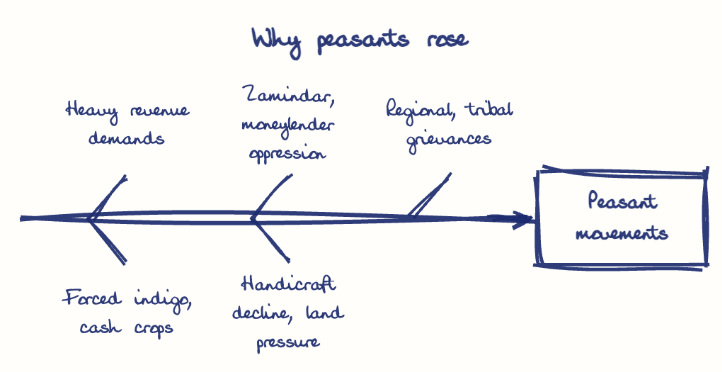
Peasant movements arose from heavy colonial land revenue, commercialisation of agriculture, and exploitation by zamindars and moneylenders, as in the Indigo Revolt (1859-60). They politicised the rural masses and broadened the national movement through Champaran, Kheda and the Kisan Sabhas, later paving the way for zamindari abolition.
Model answer
Ghissu Editorial · Verified 4 Oct 2026 · 311 words
Exploitative Land Revenue Systems
British systems like Permanent Settlement, Ryotwari, and Mahalwari imposed heavy taxes, causing widespread peasant indebtedness and poverty, which fueled resistance.
Oppression by Zamindars and Moneylenders
Peasants faced high rents, illegal levies, and forced labor demands, as seen in movements like the Eka Movement in Awadh, protesting landlord tyranny backed by colonial authorities.
Integration with National Freedom Struggle
Leaders like Gandhi and Sardar Patel supported peasant causes in Champaran and Kheda Satyagrahas, linking economic grievances with political freedom and strengthening the anti-colonial struggle.
Political Mobilization and Mass Participation
The formation of Kisan Sabhas and their affiliation with the Indian National Congress expanded the freedom struggle’s rural base, bringing peasants into active political participation.
Legacy in Agrarian Reforms
Peasant movements laid the groundwork for post-independence reforms such as the abolition of the zamindari system, addressing agrarian inequalities and decentralizing rural power.
Strengthen Rural Political Education
Build informed and sustained peasant movements by enhancing awareness of rights and socio-political contexts.
Promote Inclusive Agrarian Policies
Implement comprehensive land and credit reforms that address peasants’ economic vulnerabilities and reduce exploitation.
This model answer is indicative and the model can make mistakes; please verify key facts independently.
Practise this question
1Get the answer sheet
Sized for this question.
2Write your answer
Timed, by hand.
3Get it marked
Your score and what to fix.
This chapter in the exam
Indian Nationalism in Three Phases; Independence, Partition and After22 questions
Asked in 8 of 8 sittings since 2008
Most tested: Gandhian mass movements and their impact, alongside peasant mobilisation and communalism/partition.
- 2025Discuss the role and contributions of the moderate leaders of Congress from 1885 to 1905.
- 2025Describe the major movements led by Mahatma Gandhi between 1920 and 1947.
All 22 questions, sorted by sub-topic, with model answers and practice.
Question from the official APPSC Group-I Mains 2023 paper. Answer written by Ghissu's engine and checked against our editorial standards. Found an error? Tell us and we correct it within 48 hours.