Explain the genesis of the Inter-State Council and discuss its relevance in the context of Centre-State and Inter-State coordination and cooperation in India.
In short
The Inter-State Council was set up in 1990 under Article 263 on the Sarkaria Commission's recommendation, chaired by the Prime Minister with all Chief Ministers, and remains a relevant forum for Centre-State and inter-state dialogue. However, it has met only 11 times and its recommendations are non-binding.
Model answer
Ghissu Editorial · Verified 4 Oct 2026 · 271 words
Constitutional Backing and Sarkaria Commission
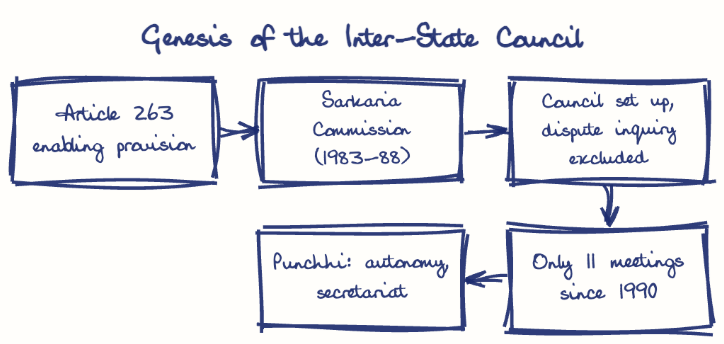
Article 263 empowers the President to form the ISC; the Sarkaria Commission (1983-88) recommended a permanent council to promote cooperative federalism, resulting in its establishment by Presidential Order in 1990.
Composition and Limitations
Chaired by the Prime Minister, including Chief Ministers and Union Ministers, the ISC’s role is recommendatory as the Presidential Order excluded dispute adjudication, a gap noted by the Punchhi Commission.
Dialogue and Trust Building
The ISC serves as a forum for Centre-State dialogue on fiscal policies like GST and social welfare, reducing mistrust, as seen in Andhra Pradesh’s Special Category Status discussions.
Challenges and Recommendations
With only 11 meetings since 1990 and non-binding recommendations, the ISC’s effectiveness is limited; the Punchhi Commission recommended institutional strengthening with an independent secretariat.
Inter-State Dialogue and Policy Harmonisation
The ISC can facilitate discussions on inter-state issues such as Krishna and Godavari water disputes (now handled by the Apex Council under the AP Reorganisation Act and tribunals) and promote coordinated regional development like the Visakhapatnam-Chennai corridor.
Limitations and Complementarity
Its lack of binding authority and infrequent meetings reduce dispute resolution effectiveness; while Article 262 tribunals and zonal councils exist, the ISC’s broader mandate remains underutilized.
This model answer is indicative and the model can make mistakes; please verify key facts independently.
Practise this question
1Get the answer sheet
Sized for this question.
2Write your answer
Timed, by hand.
3Get it marked
Your score and what to fix.
This chapter in the exam
Federal structure, Governor and distribution of powers17 questions
Asked in 8 of 8 sittings since 2008
Most tested: Centre–State balance and the extent of Union supremacy over States
- 2025The procedure of enacting a law from a bill differs at the Union and State levels, primarily to safeguard the interests of the Union Government in state legislation. Elucidate this aspect.
- 2025Although States have their separate list for law-making, this authority is not beyond the overarching legislative powers of the Parliament. Examine.
All 17 questions, sorted by sub-topic, with model answers and practice.
Question from the official APPSC Group-I Mains 2023 paper. Answer written by Ghissu's engine and checked against our editorial standards. Found an error? Tell us and we correct it within 48 hours.