Critically evaluate the role of the Smart Cities Mission in transforming urban infrastructure in India. Mention its objectives, implementation progress, key achievements and the major challenges faced.
In short
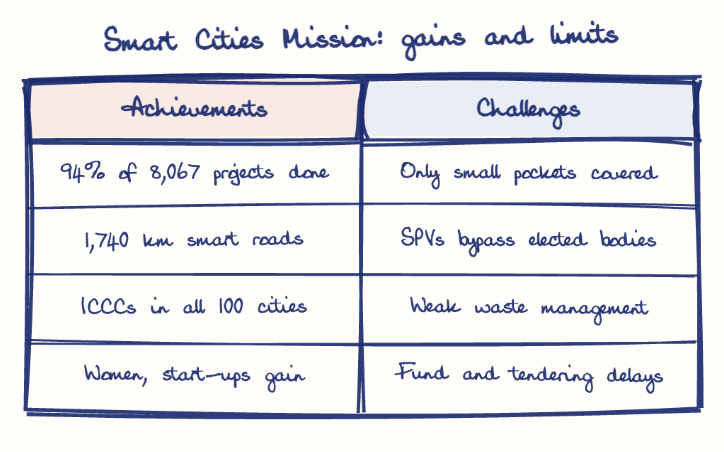
The Smart Cities Mission (2015) has visibly improved urban infrastructure, completing 94% of its 8,067 projects worth Rs 1.64 lakh crore and setting up command centres in all 100 cities. Its transformation remains partial because coverage is pocket-based, SPVs bypass elected bodies and local capacity is weak.
Model answer
Ghissu Editorial · Verified 4 Oct 2026 · 304 words
Inclusive and Tech-Driven Goals
SCM aims for balanced urbanisation by improving core infrastructure like water, sanitation, energy, and mobility. It promotes citizen-centric governance and has established Integrated Command and Control Centres (ICCCs) using AI and IoT for efficient urban management.
Robust Progress with Constraints
By 2025, 94% of 8,067 projects were completed with ₹1.64 lakh crore invested; Special Purpose Vehicles (SPVs) implement projects but raise concerns over democratic accountability. Citizen engagement varies widely, and urban local bodies (ULBs) face capacity constraints that affect timely project execution and tendering.
Infrastructure and Technology Gains
The mission has developed 1,740 km of smart roads and 713 km of cycle tracks, with ICCCs operational in all 100 cities enhancing real-time governance. Complementary schemes like AMRUT installed 99 lakh LED streetlights, significantly reducing power consumption.
Spatial and Governance Issues
Development is often confined to small pockets, such as Delhi’s 2.2 sq km NDMC area, excluding large urban populations. The SPV model bypasses elected municipal bodies, raising transparency and equity concerns. Environmental challenges persist, exemplified by Andhra Pradesh where only 4 of 123 ULBs had operational sanitary landfill sites as of 2022.
This model answer is indicative and the model can make mistakes; please verify key facts independently.
Practise this question
1Get the answer sheet
Sized for this question.
2Write your answer
Timed, by hand.
3Get it marked
Your score and what to fix.
This chapter in the exam
Infrastructure in India10 questions
Asked in 4 of 8 sittings since 2008
Most tested: Public-private partnership: scope, problems, and restructuring.
- 2025Discuss the current state of transport infrastructure in India and its contribution to economic development. Highlight key challenges and suggest policy measures for improving its efficiency and reach.
- 2025Discuss the significance of solar energy in India's renewable energy strategy. Highlight the major initiatives, achievements and challenges in the promotion of solar power.
All 10 questions, sorted by sub-topic, with model answers and practice.
Question from the official APPSC Group-I Mains 2025 paper. Answer written by Ghissu's engine and checked against our editorial standards. Found an error? Tell us and we correct it within 48 hours.