Examine the concept of 'Financial Inclusion' and its critical role in fostering inclusive growth in India. Discuss the key initiatives undertaken to promote financial inclusion and evaluate their impact on bringing the unbanked and underbanked populations into the formal financial system.
In short
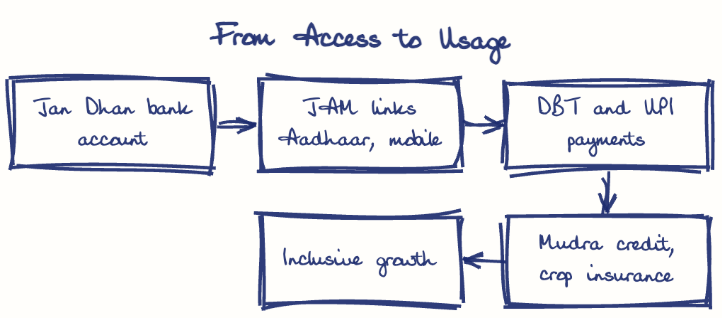
Financial inclusion means affordable access to savings, credit, insurance and payments for low-income groups, making growth inclusive through income gains, gender empowerment and resilience. PMJDY's 55 crore accounts, the JAM trinity and UPI have largely solved access, lifting the Financial Inclusion Index from 43.4 in 2017 to 67.0 in 2025.
Model answer
Ghissu Editorial · Verified 4 Oct 2026 · 268 words
Definition and Barriers
RBI’s 2019-24 National Strategy defines financial inclusion as timely credit access for weaker sections; barriers include poverty, illiteracy, limited bank branches, and high transaction costs that disproportionately affect rural and marginalized communities.
Economic and Social Impact
Financial inclusion fosters entrepreneurship and poverty reduction, exemplified by Andhra Pradesh32’s 9.24% GSDP growth in 2024-25, surpassing the national average. Social security schemes like Atal Pension Yojana (APY) and Pradhan Mantri Suraksha Bima Yojana (PMSBY) reduce vulnerability, especially in agrarian regions prone to shocks.
Major Schemes
PMJDY opened 55 crore accounts with 56% women ownership; PMFBY and PMMY improve credit and risk mitigation; the Credit Guarantee Fund Trust for Micro and Small Enterprises (CGTMSE) supports collateral-free lending to micro and small enterprises, strengthening financial access.
State-Specific Evidence
In Andhra Pradesh, PMJDY accounts, SHG-bank linkage and DBT have widened banking outreach, though women’s participation in formal finance still lags, showing that access must now turn into active usage.
This model answer is indicative and the model can make mistakes; please verify key facts independently.
Practise this question
1Get the answer sheet
Sized for this question.
2Write your answer
Timed, by hand.
3Get it marked
Your score and what to fix.
This chapter in the exam
Inclusive Growth: India and AP schemes49 questions
Asked in 8 of 8 sittings since 2008
Most tested: Women empowerment and poverty reduction through AP welfare and credit-linked institutions
- 2025Elaborate on the meaning of Inclusive Growth in the context of the Indian economy. Discuss the key strategies and instruments that can be employed to foster greater inclusion and ensure that the benefits of economic growth reach all sections of society.
- 2025Critically Examine the major poverty alleviation and employment generation programmes in India. How effective have they been in addressing rural and urban poverty?
All 49 questions, sorted by sub-topic, with model answers and practice.
Question from the official APPSC Group-I Mains 2025 paper. Answer written by Ghissu's engine and checked against our editorial standards. Found an error? Tell us and we correct it within 48 hours.