What are the challenges faced by women in India? Throw some light on the recent programmes initiated by the government for women empowerment.
In short
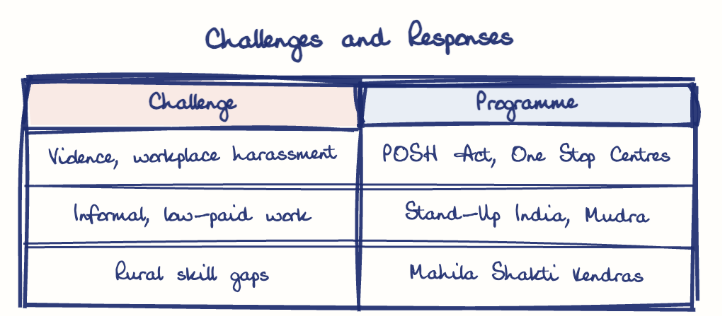
Women in India face patriarchal norms, violence, low-paid informal work, skill gaps and a digital divide, which recent programmes seek to address through legal, financial and political measures. The Nari Shakti Vandan Adhiniyam, 2023 reserves one-third of legislative seats for women, alongside Mission Shakti, Lakhpati Didi and Stand-Up India.
Model answer
Ghissu Editorial · Verified 4 Oct 2026 · 248 words
Government Initiatives
Schemes such as Beti Bachao Beti Padhao2, Pradhan Mantri Matru Vandana Yojana, Ayushman Bharat, Swachh Bharat Abhiyan, and Sukanya Samriddhi Yojana focus on health, education, sanitation, and financial inclusion for women.
State-Level Programmes
Andhra Pradesh’s Mahila Shakti Kendras, along with central schemes like Lakhpati Didi and Drone Didi implemented in the state, empower rural women via skill development and digital literacy, reflecting localized efforts.
Socio-Economic Barriers
Patriarchal norms restrict women’s mobility and employment; female labour force participation is 41.7% (2023-24), mostly in informal sectors without security.
Enhance Support and Skills
Expand One Stop Centres and Working Women Hostels, especially in Rayalaseema, Andhra Pradesh, and tailor skill development to market needs with flexible work options.
Bridge Digital and Health Gaps
Improve rural women’s internet access and digital literacy; invest in health workforce and facilities to boost maternal and reproductive health.
This model answer is indicative and the model can make mistakes; please verify key facts independently.
Practise this question
1Get the answer sheet
Sized for this question.
2Write your answer
Timed, by hand.
3Get it marked
Your score and what to fix.
This chapter in the exam
Inclusive Growth: India and AP schemes49 questions
Asked in 8 of 8 sittings since 2008
Most tested: Women empowerment and poverty reduction through AP welfare and credit-linked institutions
- 2025Elaborate on the meaning of Inclusive Growth in the context of the Indian economy. Discuss the key strategies and instruments that can be employed to foster greater inclusion and ensure that the benefits of economic growth reach all sections of society.
- 2025Critically Examine the major poverty alleviation and employment generation programmes in India. How effective have they been in addressing rural and urban poverty?
All 49 questions, sorted by sub-topic, with model answers and practice.
Question from the official APPSC Group-I Mains 2025 paper. Answer written by Ghissu's engine and checked against our editorial standards. Found an error? Tell us and we correct it within 48 hours.