Discuss the discovery of Raman effect by Dr. C.V. Raman. How did his work impact the global scientific community?
In short
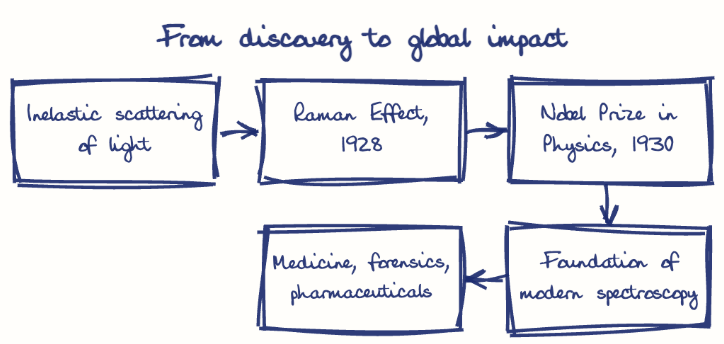
In 1928 Raman discovered the inelastic scattering of light, the Raman Effect, at the Indian Association for the Cultivation of Science in Kolkata. It won him the 1930 Nobel Prize in Physics, the first for an Asian in science, and became a cornerstone of spectroscopy worldwide.
Model answer
Ghissu Editorial · Verified 4 Oct 2026 · 245 words
Nobel Prize and Global Validation
Raman’s work on inelastic light scattering won him the 1930 Nobel Prize, the first for an Asian in sciences, boosting India’s international scientific reputation.
Legacy Institutions
The Raman Research Institute in Bengaluru, founded by Raman in 1948, continues to promote advanced research in physics and related fields.
Overcoming Constraints
Despite colonial-era resource limits, Raman’s experiments proved intellectual rigor can surpass material shortages, inspiring future Indian scientists.
Applied Science Impact
The Raman Effect underpins spectroscopy techniques vital to chemistry, biology, and pharmaceuticals, with significant research in Andhra Pradesh’s institutions.
Foundation for Modern Science
The discovery revolutionized molecular spectroscopy and interdisciplinary research, fostering advances in nanotechnology and medical diagnostics.
Strategic Autonomy
Raman’s legacy supports India’s Aatmanirbhar Bharat vision, emphasizing indigenous scientific capacity, including in Andhra Pradesh.
Enhance Infrastructure and Collaboration
Boost funding for Andhra Pradesh’s research centers and promote international scientific partnerships inspired by Raman’s vision.
Expand Science Education
Integrate Raman Effect experiments into Andhra Pradesh’s curricula and strengthen National Science Day celebrations to inspire youth.
This model answer is indicative and the model can make mistakes; please verify key facts independently.
Sources
Practise this question
1Get the answer sheet
Sized for this question.
2Write your answer
Timed, by hand.
3Get it marked
Your score and what to fix.
This chapter in the exam
Science, Technology & Innovation: policies, institutions, achievements20 questions
Asked in 7 of 8 sittings since 2008
Most tested: Science and technology policy and mission-mode institutions
- 2025Evaluate the impact of Internet of Things (IoT) technologies on the automation of household systems. Illustrate how everyday tasks have evolved due to IoT innovations.
- 2025Which are the major scientific institutes located in Andhra Pradesh? Discuss the role of IISER Tirupati in the scientific and educational development of the state.
All 20 questions, sorted by sub-topic, with model answers and practice.
Question from the official APPSC Group-I Mains 2025 paper. Answer written by Ghissu's engine and checked against our editorial standards. Found an error? Tell us and we correct it within 48 hours.