Discuss the key objectives and features of the National Policy on Information Technology, 2012. How does it aim to transform India into a digitally empowered society?
In short
The National Policy on Information Technology, 2012 aims to use ICT for social services, revive electronics manufacturing, expand e-governance and make at least one person per household e-literate, through broadband, mobile-first services, local languages and cybersecurity. It targeted IT revenues of USD 300 billion by 2020.
Model answer
Ghissu Editorial · Verified 4 Oct 2026 · 286 words
Enhancing Social Services via ICT
The policy aims to improve education, health, and welfare through ICT, supported by platforms like DigiLocker2 and UMANG, ensuring wider access and efficiency.
Reviving Electronics Manufacturing
It targets growth in the Electronics System Design and Manufacturing sector to reduce import dependence and foster self-reliance, alongside targets of USD 300 billion IT revenue by 2020, 10 million additional skilled workers and one e-literate person in every household.
E-Governance and Digital Inclusion
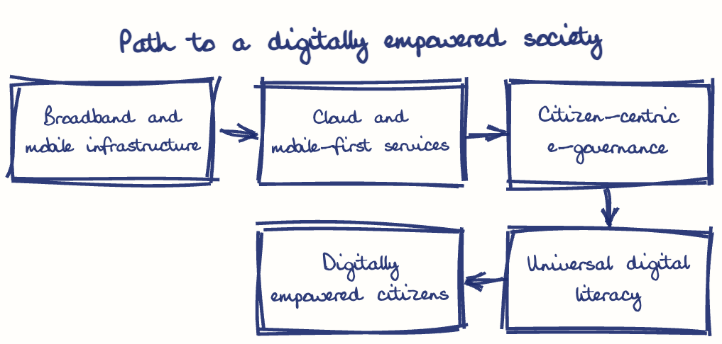
Promoting citizen-centric services via Aadhaar, UPI, and multilingual platforms, enhancing transparency and accessibility. The policy also advocates cloud-based, mobile-first applications and open standards to boost interoperability.
Bridging the Digital Divide
Expanding internet access and digital literacy through the national Pradhan Mantri Gramin Digital Saksharta Abhiyan, implemented widely in Andhra Pradesh, empowering marginalized groups.
Economic Empowerment and Innovation
Supporting start-ups and integrating ICT in sectors like health and agriculture to boost growth, as seen in Andhra Pradesh’s digital health infrastructure and ESDM sector promotion, creating jobs and enhancing competitiveness.
This model answer is indicative and the model can make mistakes; please verify key facts independently.
Practise this question
1Get the answer sheet
Sized for this question.
2Write your answer
Timed, by hand.
3Get it marked
Your score and what to fix.
This chapter in the exam
Information and Communication Technology (ICT)24 questions
Asked in 8 of 8 sittings since 2008
Most tested: E-governance and digital public service delivery
- 2025Discuss the evolution of e-governance in India, highlighting key initiatives. Analyze how these initiatives have transformed public service delivery and enhanced citizen engagement.
- 2025Define cybercrime. Discuss the major types of cybercrimes prevalent in India today.
All 24 questions, sorted by sub-topic, with model answers and practice.
Question from the official APPSC Group-I Mains 2025 paper. Answer written by Ghissu's engine and checked against our editorial standards. Found an error? Tell us and we correct it within 48 hours.