Discuss the legislative framework for controlling air and water pollution in India. Highlight the key provisions and limitations of relevant acts.
In short
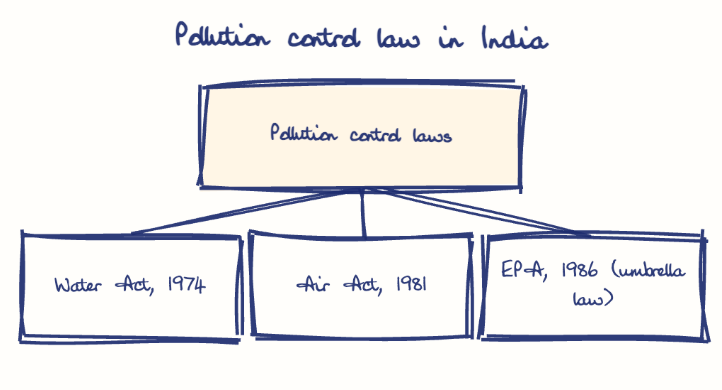
India controls air and water pollution through the Water Act, 1974 and Air Act, 1981, which created CPCB and SPCBs and a consent regime, and the umbrella Environment Protection Act, 1986. Their impact is limited by understaffed SPCBs, persistent non-compliance and the 2023-24 decriminalisation amendments that weaken deterrence.
Model answer
Ghissu Editorial · Verified 4 Oct 2026 · 283 words
Pollution Control Boards and Consent Mechanism
The Water Act (1974) and Air Act (1981) established CPCB and SPCBs to regulate pollution through a two-stage consent process for industries, requiring prior approval before establishment and operation to ensure pollution control measures.
Environment Protection Act and Amendments
The 1986 Act provides overarching powers to the central government for environmental protection. Recent amendments under the Jan Vishwas Act (2023) introduced fines replacing many criminal sanctions and delegated adjudication powers, sparking debate on enforcement efficacy and potential weakening of regulatory authority.
Capacity and Compliance Issues
SPCBs face understaffing, lack of technical expertise, and financial constraints, leading to poor enforcement. Andhra Pradesh audits reveal solid waste management deficiencies that add to water pollution, reflecting broader institutional weaknesses.
Judicial Push and Fragmented Jurisdiction
The Supreme Court has urged uniform enforcement of noise pollution rules5, highlighting judicial activism in pollution control. Inter-state river basins like Krishna and Godavari require better coordination among states, which is often lacking due to fragmented jurisdiction over water resources.
Strengthen SPCBs and Harmonise Laws
Invest in technical capacity, adequate staffing, and financial resources for SPCBs, and promote uniform adoption of amendments, especially in Andhra Pradesh, to improve monitoring and enforcement.
This model answer is indicative and the model can make mistakes; please verify key facts independently.
Practise this question
1Get the answer sheet
Sized for this question.
2Write your answer
Timed, by hand.
3Get it marked
Your score and what to fix.
This chapter in the exam
Pollution & solid waste; global issues; environmental legislation; disaster management policy; agricultural revolutions43 questions
Asked in 8 of 8 sittings since 2008
Most tested: Solid waste management and pollution-control legislation
- 2025What are the key principles of Integrated Solid Waste Management (ISWM)? Discuss the role of waste hierarchy in ISWM.
- 2025Define global warming, and differentiate it clearly from climate change. Explain the key natural and human-induced causes of global warming and briefly discuss which factors are currently dominant in driving global temperature rise.
All 43 questions, sorted by sub-topic, with model answers and practice.
Question from the official APPSC Group-I Mains 2025 paper. Answer written by Ghissu's engine and checked against our editorial standards. Found an error? Tell us and we correct it within 48 hours.